
The speed of sound is the distance travelled during a unit of time by a sound wave propagating through an elastic medium.
To the frequent question 'what is the speed of sound?', the reply should be 'in which medium and at what temperature?'. In common everyday speech, speed of sound refers to the speed of sound waves in air. The speed of sound in air is only dependent on the temperature. It is completely independent of the air pressure. Therefore the speed of sound is the same on a mountain peak as it is at sea level, provided that the temperature is the same. In dry air at 20°C, the speed of sound is 343.2 metres per second but this is only a particular case.
For a gas, K (the bulk modulus, equivalent to C, the coefficient of stiffness in solids) is approximately given by
thus

Where:
γ is the adiabatic index also known as the isentropic expansion factor. It is the ratio of specific heats of a gas at a constant-pressure to a gas at a constant-volume(Cp / Cv), and arises because a classical sound wave induces an adiabatic compression, in which the heat of the compression does not have enough time to escape the pressure pulse, and thus contributes to the pressure induced by the compression. p is the pressure. ρ is the density
Using the ideal gas law to replace p with nRT/V, and replacing ρ with nM/V, the equation for an ideal gas becomes:

where
This equation applies only when the sound wave is a small perturbation on the ambient condition, and the certain other noted conditions are fulfilled, as noted below. Calculated values for cair have been found to vary slightly from experimentally determined values.[4]
Newton famously considered the speed of sound before most of the development of thermodynamics and so incorrectly used isothermal calculations instead of adiabatic. His result was missing the factor of γ but was otherwise correct.
Numerical substitution of the above values gives the ideal gas approximation
of sound velocity for gases, which is accurate at relatively low gas pressures
and densities (for air, this includes standard Earth sea-level conditions).
Also, for diatomic gases the use of
 requires that the gas exist in a temperature range high enough that rotational
heat capacity is fully excited (i.e., molecular rotation is fully used as a heat
energy "partition" or reservoir); but at the same time the temperature must be
low enough that molecular vibrational modes contribute no heat capacity (i.e.,
insignificant heat goes into vibration, as all vibrational quantum modes above
the minimum-energy-mode, have energies too high to be populated by a significant
number of molecules at this temperature). For air, these conditions are
fulfilled at room temperature, and also temperatures considerably below room
temperature (see tables below). See the section on gases in
specific heat capacity for a more complete discussion of this phenomenon.
requires that the gas exist in a temperature range high enough that rotational
heat capacity is fully excited (i.e., molecular rotation is fully used as a heat
energy "partition" or reservoir); but at the same time the temperature must be
low enough that molecular vibrational modes contribute no heat capacity (i.e.,
insignificant heat goes into vibration, as all vibrational quantum modes above
the minimum-energy-mode, have energies too high to be populated by a significant
number of molecules at this temperature). For air, these conditions are
fulfilled at room temperature, and also temperatures considerably below room
temperature (see tables below). See the section on gases in
specific heat capacity for a more complete discussion of this phenomenon.
The speed of sound in an ideal gas is independent of frequency
The ideal gas law is based on a simple picture of a gas as a large number of molecules which move independently of one another, except for occasional collisions with each other or with the walls of their container. When they do collide, the collision occurs with no net loss of energy -- that is, it is an elastic collision.
The ideal gas model predicts that the speed of sound in a pure gas will be
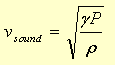
where γ is the adiabatic constant (specific heat ratio) for the gas, which at room temperature depends mostly on the shape of the molecule and will have a value just a bit larger than 1, P is the absolute pressure of the gas, and ρ is the density of the gas. Using the ideal gas law, PV = nRT (with n constant, that is the number of gas molecules is constant), the equation above can be rewritten as
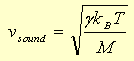
where T is the temperature on an absolute scale (e.g. Kelvin), M is the mass of one gas molecule, and kB is Boltzmann's constant which converts absolute temperature units to energy units. Note that if the ideal gas model is a good model for a real gas, then you can expect, for any specific gas, that there will be no pressure dependence for the speed of sound. This is because as you change the pressure of the gas, you will also change its density by the same factor. The speed of sound will have a very significant dependence on temperature and on the mass of the molecules which make up the gas.
For comparison the "root mean square" (or "rms") velocity of the molecules in an ideal gas, an appropriate average for the speed of molecules in the gas, is given by
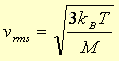
and since γ is typically between 1.2 and 1.7, you can see that the average speed of the molecules is closely related to the speed of sound and will be only slightly larger. For typical air at room conditions, the average molecule is moving at about 500 m/s (close to 1000 miles per hour). Note that the speed of sound is largely determined by how fast the molecules move between collisions, and not on how often they make collisions. This is because no energy is lost during the collisions. The collisions do not "slow things down" but simply randomize the motion -- which was already quite random. At higher temperatures the molecules have more energy and are moving faster than at lower temperatures, hence the speed of sound at higher temperatures is faster than at lower temperatures.
For all real physical situations, the speed of sound weakly depends on frequency . It is a function of the square root of temperature, but is nearly independent of pressure or density for a given gas. For different gases, the speed of sound is inversely dependent on square root of the mean molecular weight of the gas, and affected to a lesser extent by the number of ways in which the molecules of the gas can store heat from compression, since sound in gases is a type of compression. Although, in the case of gases only, the speed of sound may be expressed in terms of a ratio of both density and pressure, these quantities are not fully independent of each other, and cancelling their common contributions from physical conditions, leads to a velocity expression using the independent variables of temperature, composition, and heat capacity noted above.
All for 20ºC, 1 Atm, audible frequencies. Extrapolated from tables in the reference below. Consult that reference for other conditions.
| Gas | Speed of Sound (m/s) |
|---|---|
| Argon | 319 |
| Helium | 1007 |
| Krypton | 221 |
| Xenon | 76 |
| Hydrogen | 1270 |
| Nitrogen | 349 |
| Oxygen | 326 |
| Carbon Dioxide | 267 |
| Sulfur Dioxide | 201 |
| Ethylene | 327 |
| Methane | 446 |
| Propane | 258 |
In common everyday speech, speed of sound refers to the speed of sound waves in air.
For air, we use a simplified symbol
 .
.
Additionally, if temperatures in degrees Celsius(°C)
are to be used to calculate air speed in the region near 273 kelvin, then
Celsius temperature
 may be used. Then:


For dry air, where
 (theta) is the temperature in degrees Celsius(°C).
Making the following numerical substitutions:

is the molar gas constant in J/mole/Kelvin;

is the mean molar mass of air, in kg; and using the ideal diatomic gas value
of

Then:

Using the first two terms of the Taylor expansion:


The derivation includes the first two equations given in the Practical formula for dry air section above.
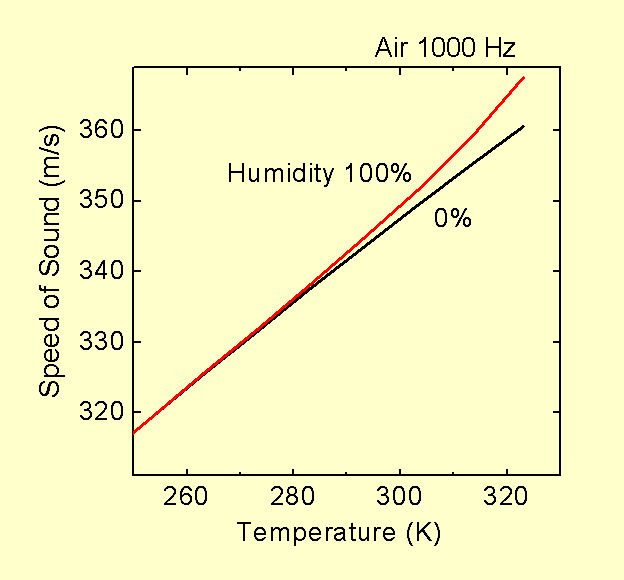
For air, which is a mixture of molecules, you will need to use average values for the adiabatic constant and molecular mass. Air is mostly N2 and O2, which are both simple diatomic molecules with almost the same masses. The adiabatic constant will be very close to 1.4 for both molecules for a wide range of temperatures near room temperature. Hence the adiabatic constant will also be close to 1.4 for air. The average molecular mass will depend on the air composition which changes slightly, for example due to day to day variations in relative humidity. For 100% relative humidity under normal room conditions, about 4% of the molecules of air are water molecules. Since the mass of a water molecule is almost half that of an oxygen or nitrogen molecule, the larger the humidity the lower the density of the air for the same pressure and temperature. At room temperatures the fraction of air which is water is small (<5% typically), and so the effect will not be large. Some very small variations can be expected for other variations in air content, such as in CO2 content. CO2 molecules are about 50% heavier than O2 and N2 molecules and so will increase the density. The fraction of air which is CO2 is so small (0.04%) that the effects due to CO2 are very small as well. For air expelled from human lungs, however, the CO2 concentration is typically 4 to 5%, with a corresponding decrease in O2 concentration, and that can cause effects comparable to changes in humidity.
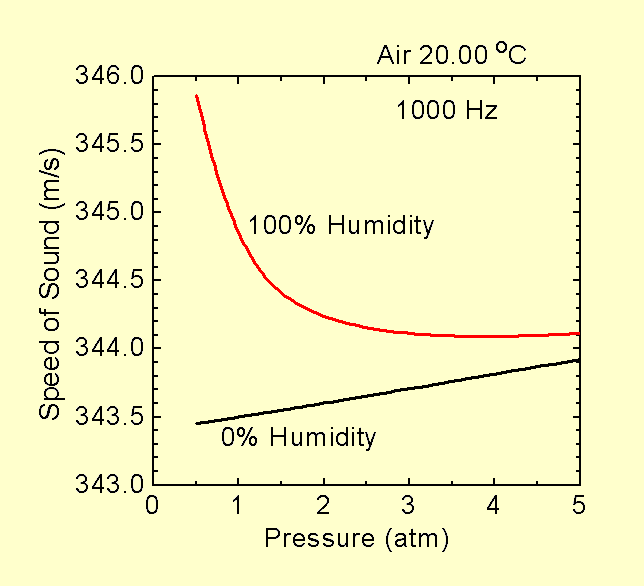
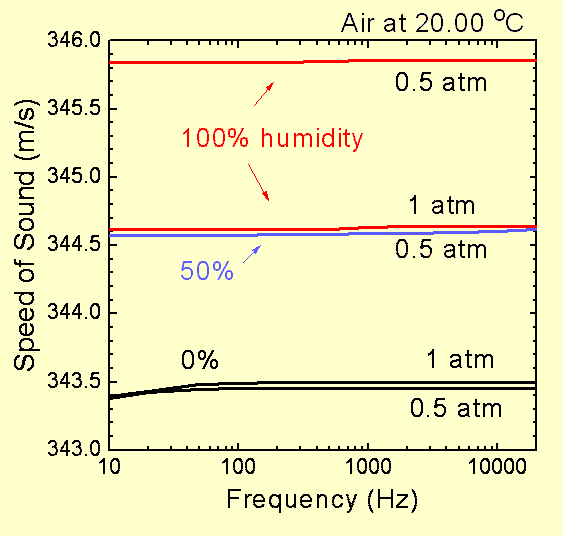
For normal air the temperature dependence and the change in density due to changes in composition, the latter almost entirely due to changes in humidity, are by far the two largest causes for variations in the speed of sound. Note, however, that humidity is normally expressed as a percentage of the maximum concentration for the air. That maximum may change with conditions. What matters for the speed of sound is the fraction of the air molecules which are water (i.e. the "molar fraction"). The molar fraction corresponding to 100% humidity will depend on temperature and pressure. Hence there may be an apparent dependence on pressure when the water content is expressed as a percent relative humidity rather than a molar fraction. For example, if you take 20 oC air at 1 atm and 100% humidity and remove half of the molecules, you end up with air at 0.5 atm and about 50% relative humidity, not 100% humidity. Hence to look at the changes due only to changes in pressure, and not molecular composition, you would need to compare air at 1 atm and 100% humidity with air at 0.5 atm and 50% humidity.
There are some additional small effects related to the details of the exchange of energy between the molecules. These effects give rise to non-ideal gas behaviour. In particular, they can cause dissipation of sound energy (that is, the sound energy is turned into heat energy). For normal atmospheric conditions, the effects on the speed of sound are very small, but can also give rise to very small variations in the speed of sound with frequency. For a comprehensive discussion of these and other effects, see the reference below.
Here are some graphs illustrating how the speed of sound in real air depends on temperature, pressure, humidity and frequency. Data for these graphs is from tables contained in the reference below. Note that a pressure of 0.5 atm corresponds to an altitude of just under 6,000 m (20,000 ft) above sea level and 20 oC is "room temperature" (20.00 oC = 293.15 K). Day to day changes in atmospheric pressure due to weather are about plus or minus 5% (e.g. from about 0.95 to 1.05 atmospheres at sea level).
 |
 |
 |
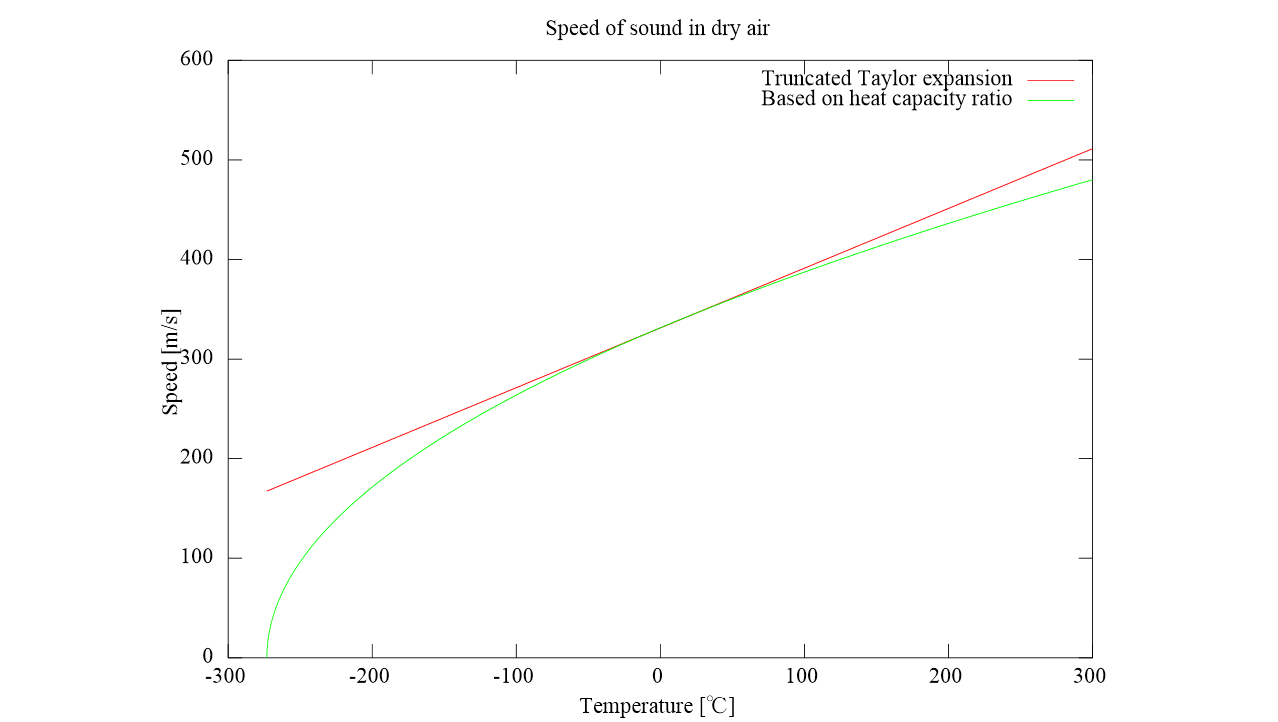
Approximation of the speed of sound in dry air based on the heat capacity ratio (in green) against the truncated Taylor expansion (in red).
The approximate speed of sound in dry (0% humidity) air, in meters per second (m·s−1), at temperatures near 0 °C, can be calculated from:

where
 is the temperature in degrees Celsius (°C).
This equation is derived from the first two terms of the Taylor expansion of the following more accurate equation:

Dividing the first part, and multiplying the second part, on the right hand
side, by
 gives the exactly equivalent form:

The value of 331.3 m/s, which represents the 0 °C speed, is based on theoretical (and some measured) values of the heat capacity ratio, γ, as well as on the fact that at 1 atm real air is very well described by the ideal gas approximation. Commonly found values for the speed of sound at 0 °C may vary from 331.2 to 331.6 due to the assumptions made when it is calculated. If ideal gas γ is assumed to be 7/5 = 1.4 exactly, the 0 °C speed is calculated (see section below) to be 331.3 m/s, the coefficient used above.
This equation is correct to a much wider temperature range, but still depends on the approximation of heat capacity ratio being independent of temperature, and for this reason will fail, particularly at higher temperatures. It gives good predictions in relatively dry, cold, low pressure conditions, such as the Earth's stratosphere. The equation fails at extremely low pressures and short wavelengths, due to dependence on the assumption that the wavelength of the sound in the gas is much longer than the average mean free path between gas molecule collisions. A derivation of these equations will be given in the following section.
A graph comparing results of the two equations is at right, using the slightly different value of 331.5 m/s for the speed of sound °C.
This calculation shows the speed of sound in humid air according to Owen Cramer, "JASA, 93, p. 2510, 1993", with saturation vapor pressure taken from Richard S. Davis, "Metrologia, 29, p. 67, 1992", and a mole fraction of carbon dioxide of 0.0004. The calculator is valid over the temperature range 0 to 30°C (273.15 to 303.15 K) and over the pressure range 75 to 102 kPa. In the region between the air pressures 95 und 104 kPa there is no noticeable changing of the speed of sound c. The standard airpressure is 101325 Pa = 101.325 kPa or 1013.25 hectopascal.
The speed of sound in air is determined by the air itself and is not dependent upon the amplitude, frequency, or wavelength of the sound. For an ideal gas the speed of sound depends only on the temperature and is independent of gas pressure. This dependence also applies really good to air, in good approximation and can be regarded as an ideal gas. Environmental effects change the speed of sound and the absorption of sound in air. Even seemingly small percentage changes may cause serious listening problems in enclosed acoustic spaces. The air pressure is entered here anyway, it could be that you have to involve a pressure far from normal. Don't forget, this is a site for sound designers.
Notice for musicians and technicians (not for physics professors): The speed of sound changes clearly with temperature, a little bit with humidity − but not with atmospheric pressure (atmospheric pressure). The words "sound pressure at sea level" are incorrect and misleading in the case of "speed of sound". The temperature indication, however, is absolutely necessary. The changing of atmospheric pressure does not change the sound of musical instruments in concert halls or in a rooms.
| In SI units with dry air at 20°C (68°F),
the speed of sound c is 343 meters
per second (m/s). This also equates to 1235 km/h, 767 mph, 1125 feet per second (ft/s), or 666 knots. 767.3 miles per hour (mph), 12.79 miles per minute (mi/min), 0.2131 miles per second (mi/s), That is 0.343 kilometers per second (km/s), or 20.58 kilometers per minute (km/min). It makes no sense to give the speed of sound adding the words at the "standard atmosphere at sea level". To get the speed of sound the temperature is important, not the barometric pressure. Statement: The static air pressure p_ and the density ρ of air (air density) are proportional at the same temperature. The ratio p_ / ρ is always constant, on a high mountain or even on sea level altitude. |
 |
That means, the ratio p_ / ρ is always constant on a high mountain, and even at "sea level". The static atmospheric pressure p_ and the density of air ρ go always together. The ratio stays constant. When calculating the speed of sound forget the atmospheric pressure, but look accurately at the very important temperature. The speed of sound varies with altitude (height) only because of the changing temperature! |
Adiabatic index or ratio of specific heats κ (kappa) = cp
/ cv.
κ = 1.67 for
monatomic molecules, 1.40 für diatomic molecules and 1.33 for triatomic
molecules.
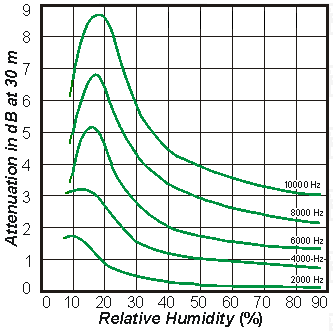
| Frequency dependent attenuation of air
(dB) in 30 m distance at different humidity (percent) |
 |
Air Density Calculations
First, consider the ideal gas law:
(1) p × V = n × R × T
| p = pressure, pascals (multiply mb by 100 to get pascals) |
| V = volume in m3 |
| n = number of moles |
| R = specific gas constant |
| T= temperature K = °C + 273.15 |
Density D = ρ is the number
of molecules of the ideal gas in a certain volume.
In this case a molar volume, which can be mathematically expressed as:
(2) D = ρ = n / V
| D = ρ = density in kg/m3 |
| n = number of molecules |
| V = volume in m3 |
By combining the previous two equations, the expression for the density D = ρ becomes:
(3)

| D = ρ = density in kg/m3 |
| p = pressure, pascals (multiply mb by 100 to get pascals) |
| R =specific gas constant = 287.058 J / (kg · K) for dry air |
| T = temperature K = °C + 273.15 |
As an example, using the standard sea level
conditions of P = 101325 Pa and T = 15°C,
the air density at sea level, can be calculated as:
D = ρ = 101325 / (287.058 × (15 + 273.15)) = 1.2250 kg/m3
This example has been derived for the dry
air of the standard conditions. For real-world situations,
it is necessary to understand how the density is affected by the moisture in the
air.
The density D = ρ of a mixture of dry air molecules and water vapor molecules can be expressed as:
(4)
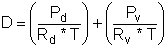
| D = ρ = density in kg/m3 |
| pd = pressure of dry air in pascals |
| pv = pressure of water vapor in pascals |
| Rd = specific gas constant for dry air = 287.05 J / (kg · K) |
| Rv = gas constant for water vapor 461.495 J / (kg · K) |
| T = temperature K = °C + 273.15 |
To determine the density of the air, it is
necessary to know the actual air pressure, also
known as absolute pressure, or station pressure, the water vapor pressure, and
the temperature.
| Calculation of the wavelength with
frequency and temperature Speed of sound - temperature matters, not air pressure Calculation of the wavelength of radio waves and acoustic waves |
The speed of sound in water is
approximately 1500 m/s. It is possible to measure changes
in ocean temperature by observing the resultant change in speed of sound over
long distances.
The speed of sound in an ocean is approximately:
c
= 1449.2 + 4.6 × T - 0.055 × T2 + 0.00029 × T3 + (1.34 - 0.01 × T) · (s
- 35) + 0.0163 × z
T = temperature in degrees Celsius
s = salinity in parts per thousand
z = depth in meters
Table (chart): The impact of temperature
Speed of sound, density of air, specific acoustic
impedance vs. temperature
| Temperature of air  in °C in °C |
Speed of sound c in m/s |
Time per 1 m Δ t in ms/m |
Density of air ρ in kg/m3 |
Impedance of air Z in N·s/m3 |
| +35 | 351.96 | 2.840 | 1.1455 | 403.2 |
| +30 | 349.08 | 2.864 | 1.1644 | 406.5 |
| +25 | 346.18 | 2.888 | 1.1839 | 409.4 |
| +20 | 343.26 | 2.912 | 1.2041 | 413.3 |
| +15 | 340.31 | 2.937 | 1.2250 | 416.9 |
| +10 | 337.33 | 2.963 | 1.2466 | 420.5 |
| +5 | 334.33 | 2.990 | 1.2690 | 424.3 |
| 0 | 331.30 | 3.017 | 1.2920 | 428.0 |
| −5 | 328.24 | 3.044 | 1.3163 | 432.1 |
| −10 | 325.16 | 3.073 | 1.3413 | 436.1 |
| −15 | 322.04 | 3.103 | 1.3673 | 440.3 |
| −20 | 318.89 | 3.134 | 1.3943 | 444.6 |
| −25 | 315.72 | 3.165 | 1.4224 | 449.1 |
Notice: Air pressure p and air density ρ are not the same.
In gases, the higher the velocity of sound, the higher the pitch will be, when
you sing.
Only because of the decreasing air temperature, which decreases with altitude, the speed of sound decreases.
| Sound waves and electromagnetic waves are different.
Sound waves need a medium to travel through, while the electromagnetic waves do not. The properties of a sound wave depend on the properties of the medium it travels through. |
Change of speed of sound with the change in height
| The standard table: Speed of Sound at Different Altitudes The speed of sound is not a constant, but depends actually on the temperature at that altitude. The speed of sound changes only with temperature. Sure, it's just very cold up there. |
Change of air pressure associated with the change in height
| Question: How does the air pressure change if
the height changes 1 meter? The hydrostatic pressure is calculated according to Blaise Pascal: 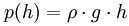 This law is also assumed as an air column. Height h = 1 m Standard gravitational acceleration is g = 9.80665 m/s2 Density of air at 20°C is ρ20 = 1.204 kg/m3 1 m height changes the air pressure at a constant temperature of 20°C by p = ρ20 ∙ g ∙ h = 1.204 kg/m3 × 9.80665 m/s2 × 1 m = 11.8 Pa (N/m²) Rule of thumb: At ground level the air pressure decreases by 1 hPa = 100 Pa with an altitude change of 8.5 meters. But the temperature has a tendency to decrease with height. |
In the Earth's atmosphere, the most important factor affecting the speed of sound is the temperature (see Details below). Since temperature and thus the speed of sound normally decrease with increasing altitude, sound is refracted upward, away from listeners on the ground, creating an acoustic shadow at some distance from the source.[2] The decrease of the sound speed with height is referred to as a negative sound speed gradient. However, in the stratosphere, the speed of sound increases with height due to heating within the ozone layer, producing a positive sound speed gradient.
Zonal mean vertical profile of temperature in the atmosphere during June at 45° North
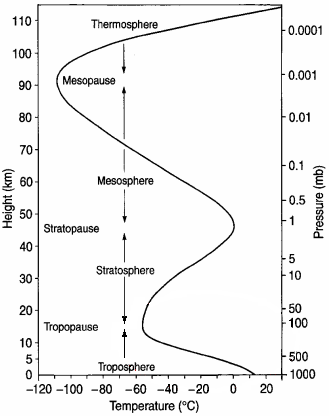
Temperature vs. Height (Atmospheric Pressure)
In the standard atmosphere:
In fact, assuming an ideal gas, the speed of sound c depends on temperature only, not on the pressure or density (since these change in lockstep for a given temperature and cancel out). Air is almost an ideal gas. The temperature of the air varies with altitude, giving the following variations in the speed of sound using the standard atmosphere - actual conditions may vary.
| Temperature | Speed of sound | Density of air | Acoustic impedance |
|---|---|---|---|
|
in °C |
c in m·s−1 | ρ in kg·m−3 | Z in N·s·m−3 |
| +35 | 351.96 | 1.1455 | 403.2 |
| +30 | 349.08 | 1.1644 | 406.5 |
| +25 | 346.18 | 1.1839 | 409.4 |
| +20 | 343.26 | 1.2041 | 413.3 |
| +15 | 340.31 | 1.2250 | 416.9 |
| +10 | 337.33 | 1.2466 | 420.5 |
| +5 | 334.33 | 1.2690 | 424.3 |
| ±0 | 331.30 | 1.2920 | 428.0 |
| -5 | 328.24 | 1.3163 | 432.1 |
| -10 | 325.16 | 1.3413 | 436.1 |
| -15 | 322.04 | 1.3673 | 440.3 |
| -20 | 318.89 | 1.3943 | 444.6 |
| -25 | 315.72 | 1.4224 | 449.1 |
Given normal atmospheric conditions, the temperature, and thus speed of sound, varies with altitude:
| Altitude | Temperature | m·s−1 | km·h−1 | mph | knots |
| Sea level | 15 °C (59 °F) | 340 | 1225 | 761 | 661 |
| 11 000 m−20 000 m (Cruising altitude of commercial jets, and first supersonic flight) | −57 °C (−70 °F) | 295 | 1062 | 660 | 573 |
| 29 000 m (Flight of X-43A) | −48 °C (−53 °F) | 301 | 1083 | 673 | 585 |
The medium in which a sound wave is travelling does not always respond adiabatically, and as a result the speed of sound can vary with frequency.[11]
The limitations of the concept of speed of sound due to extreme attenuation are also of concern. The attenuation which exists at sea level for high frequencies applies to successively lower frequencies as atmospheric pressure decreases, or as the mean free path increases. For this reason, the concept of speed of sound (except for frequencies approaching zero) progressively loses its range of applicability at high altitudes.:[4] The standard equations for the speed of sound apply with reasonable accuracy only to situations in which the wavelength of the soundwave is considerably longer than the mean free path of molecules in a gas.
The molecular composition of the gas contributes both as the mass (M) of the molecules, and their heat capacities, and so both have an influence on speed of sound. In general, at the same molecular mass, monatomic gases have slightly higher sound speeds (over 9% higher) because they have a higher γ (5/3 = 1.66...) than diatomics do (7/5 = 1.4). Thus, at the same molecular mass, the sound speed of a monatomic gas goes up by a factor of
 = 1.091...
This gives the 9 % difference, and would be a typical ratio for sound speeds at room temperature in helium vs. deuterium, each with a molecular weight of 4. Sound travels faster in helium than deuterium because adiabatic compression heats helium more, since the helium molecules can store heat energy from compression only in translation, but not rotation. Thus helium molecules (monatomic molecules) travel faster in a sound wave and transmit sound faster. (Sound generally travels at about 70% of the mean molecular speed in gases).
Note that in this example we have assumed that temperature is low enough that heat capacities are not influenced by molecular vibration (see heat capacity). However, vibrational modes simply cause gammas which decrease toward 1, since vibration modes in a polyatomic gas gives the gas additional ways to store heat which do not affect temperature, and thus do not affect molecular velocity and sound velocity. Thus, the effect of higher temperatures and vibrational heat capacity acts to increase the difference between sound speed in monatomic vs. polyatomic molecules, with the speed remaining greater in monatomics.
| At 0°C is ρ0 = 1.293 kg/m3, Z0 = 428 N·s/m3,
and c0 = 331 m/s At 15°C is ρ20 = 1.225 kg/m3, Z20 = 417 N·s/m3, and c20 = 340 m/s At 20°C is ρ20 = 1.204 kg/m3, Z20 = 413 N·s/m3, and c20 = 343 m/s At 25°C is ρ20 = 1.184 kg/m3, Z25 = 410 N·s/m3, and c25 = 346 m/s |
Air density
or density of air
ρ (rho), air impedance
Z, speed of sound
c
| The speed of sound in air is determined
by the air itself and is not dependent upon the amplitude, frequency, or wavelength of the sound. For an ideal gas the speed of sound depends only on the temperature and is independent of gas pressure. This dependence also applies to air, in good approximation and can be regarded as an ideal gas. This is a site for sound engineers and musicians. We are interested in the speed of sound of air (!) on Earth at places where acoustic musical instruments or voices are used, usually in rooms or halls. The speed of sound of atmospheric layers, as in 100 km altitude, or close to the vacuum is not of interest. Also we do not care about higher air pressure in car tires. Which speed does sound have? |
| Notice for musicians and
technicians (not for physics professors): The speed of sound changes clearly with temperature, a little bit with humidity − but not with air pressure (atmospheric pressure). The words "sound pressure at sea level" are incorrect and misleading in the case of "speed of sound". The temperature indication, however, is absolutely necessary. The changing of atmospheric pressure does not change the sound of musical instruments in a concert hall or in a room. |
| Google is not correct
(look at the following link) http://www.google.com/search?q=speed+of+sound+at+sea+level Here is the answer of Google: "Speed of sound at sea level = 340.29 m/s". This is not a good answer, because they forgot to tell us the important temperature, and the given atmospheric pressure "at sea level" makes really no sense. |
| In SI units with dry air at 20°C (68°F),
the speed of sound c is 343 meters
per second (m/s). This also equates to 1235 km/h, 1125 feet per second (ft/s or fps), 666 knots, 767.3 miles per hour (mi/h or mph), 12.79 miles per minute (mi/min), 0.2131 miles per second (mi/s), That is 0.343 kilometers per second (km/s), or 20.58 kilometers per minute (km/min). It makes no sense to give the speed of sound adding the words at the "standard atmosphere at sea level". To get the speed of sound the temperature is important, not the barometric pressure. Statement: The static air pressure p_ and the density ρ of air (air density) are proportional at the same temperature. The ratio p_ / ρ is always constant, on a high mountain or even on sea level altitude. |
Speed of sound
 |
That means, the ratio p_ / ρ is always constant on a high mountain, and even at "sea level". The static atmospheric pressure p_ and the density of air ρ go always together. The ratio stays constant. When calculating the speed of sound forget the atmospheric pressure, but look accurately at the very important temperature. The speed of sound varies with altitude (height) only because of the changing temperature there! |
| Adiabatic index or ratio of specific heats κ (kappa) = cp
/ cv. Generally we take with sufficient accuracy the formula (equation) for the speed of sound in air in m/s vs. temperature ϑ (theta) in degrees Celsius (centigrade):
|
| The speed of sound is called Mach 1 Mach is commonly used to represent an object's speed, such as an aircraft or a missile, when it is travelling at the speed of sound or at multiples of it. The speed higher than Mach 1 is called supersonic speed. |
| Mach number below 1 means the flow velocity is lower
than the speed of sound - and the speed is subsonic. Mach number 1 means the flow velocity is the speed of sound - and the speed around that is transonic. Mach number above 1 means the flow velocity is higher than the speed of sound - and the speed is supersonic. More than Mach number 5 is called hypersonic. |
Note: The speed of sound c is independent of the frequency and the amplitude of the sound wave. |
Table (chart): The clear impact of temperature
Speed of sound, density of air, specific acoustic
impedance vs. temperature
| Temperature of air ϑ in °C |
Speed of sound c in m/s |
Time per 1 m Δ t in ms/m |
Density of air ρ in kg/m3 |
Impedance of air Z in N·s/m3 |
| +35 | 351.96 | 2.840 | 1.1455 | 403.2 |
| +30 | 349.08 | 2.864 | 1.1644 | 406.5 |
| +25 | 346.18 | 2.888 | 1.1839 | 409.4 |
| +20 | 343.26 | 2.912 | 1.2041 | 413.3 |
| +15 | 340.31 | 2.937 | 1.2250 | 416.9 |
| +10 | 337.33 | 2.963 | 1.2466 | 420.5 |
| +5 | 334.33 | 2.990 | 1.2690 | 424.3 |
| 0 | 331.30 | 3.017 | 1.2920 | 428.0 |
| −5 | 328.24 | 3.044 | 1.3163 | 432.1 |
| −10 | 325.16 | 3.073 | 1.3413 | 436.1 |
| −15 | 322.04 | 3.103 | 1.3673 | 440.3 |
| −20 | 318.89 | 3.134 | 1.3943 | 444.6 |
| −25 | 315.72 | 3.165 | 1.4224 | 449.1 |
Notice: Air pressure p and air density ρ are not the same.
In gases, the higher the velocity of sound, the higher the pitch will be, when
you sing.
Only because of the decreasing air temperature, which decreases with altitude, the speed of sound decreases.
In conventional use and in
scientific literature sound velocity is the same as speed of sound
or acoustic velocity.
Sound velocity c should not be
confused with sound particle velocity v,
which is the velocity of the individual particles.
| Approximate speed of
sound in common materials |
|||
| Medium | Speed of sound m/s ft/s |
||
| Air, dry at 20°C | 343 | 1 125 | |
| Hydrogen at 0°C | 1 280 | 4 200 | |
| Water at 15 °C | 1 500 | 4 920 | |
| Lead | 2 160 | 7 090 | |
| Concrete | 3 100 | 10 200 | |
| Wood (soft - along the fibre) | 3 800 | 12 500 | |
| Glass | 5 500 | 18 500 | |
| Steel | 5 800 | 19 000 | |
| In a given ideal gas the speed of sound
depends only on its temperature. The speed of sound in still air at 0 degrees Celsius is 331.29 m / s. It depends on the temperature and material. Since sound is transferred easily through densely packed molecules, it is faster in denser substances. Thus the speed of sound increases with the stiffness of the material. |
| On the frequent question: "How much is
the speed of sound?" must always follow the demand: "At what temperature, please?" Who mentions the barometric pressure, has still something to learn. |
Speed of sound and acoustic velocity
| Speed is the rate of change of distance
with time. Velocity is a measure of both speed and direction of a moving object. Velocity is the rate of change of displacement with time. Speed is a distance an object goes, velocity is measurment of speed AND direction. |
| In a given ideal gas the sound speed
depends only on its temperature. The speed of sound in still air at 0 degrees Celsius is 331.29 m/s. It depends on the temperature, and the material. Since sound is more easily transmitted between close molecules, it travels faster in the denser substance. Thus the speed of sound increases with the stiffness of the material. |
Really wrong answers at "Yahoo! Answers"
| How does the speed of sound in air depend
on air pressure? 1st wrong answer: Best Answer - Chosen by Voters Thinner air has less atoms floating around in it than denser (higher pressure) air. Since sound waves travel faster when unimpeded, less air pressure equates to faster speed due to decreased atmospheric 'viscosity'. 2nd wrong answer: Speed of sound in air is directly proportional to the square root of pressure. The correct answer is: The speed of sound does not depend on air pressure, but on temperature. Air pressure is not the same as density of air. |
| Some interesting links to the speed of sound
(velocity of sound): Calculation of the speed of sound in humid air and the air pressure Calculation of the wavelength of a wave in air when frequency and temperature is known Speed of sound - temperature matters, not air pressure Pitch change by temperature change (variation) |
| Calculations and conversions of pressure
units More conversions of pressure and stress units Conversions of pressure units |
Properties of sound in air
| To use the calculator, simply enter a value. The calculator works in both directions of the ↔ sign. |
Speed and Velocity - The Difference
| Speed is the distance in a certain period
of time. Velocity is a measure of both speed and direction of a moving object. Difference: Speed is a distance an object goes in unit time. Velocity is displacement made in unit time. Difference: Speed is a scalar quantity − it only has magnitude and cannot be zero. Velocity is a vector quantity − it has both magnitude and direction and it can be zero. |
| A sentence from Jim March from the news
group "The Firing Line Forums": http://www.thefiringline.com/forums/showthread.php?p=3836426 According to him, altitude (mostly?) doesn't matter (regarding speed of sound), although of course at some point it must when you get close enough to outer space. Answer: In the outer space there is no air and consequently also no sound. |
| I am not content with this standard table Speed of Sound at Different Altitudes because it seems to tell us, that the speed of sound has to do with the altitude (height) above ground and its air pressure. The speed of sound has really to do only with the temperature. It's cold up there. |
Converter: Fahrenheit to Celsius and Celsius to Fahrenheit
| To use the calculator, simply enter a value. The calculator works in both directions of the ↔ sign. |
| Sound pressure or acoustic pressure is the local
pressure deviation from the ambient atmospheric pressure caused by a sound wave. Sound pressure can be measured using a microphone in air. The SI unit for sound pressure p is the pascal − symbol: Pa. |
| NASA says: The speed of sound is dependent on the
temperature of the air. It varies with altitude (height) only because of the changing temperature! The atmospheric pressure is proportional to the density of air. Therefore both values have no effect on the speed of sound. |
| "Speed of sound":
http://www.grc.nasa.gov/WWW/k-12/airplane/sound.html "Speed of sound": http://www.grc.nasa.gov/WWW/BGH/sound.html "Atmos Modeler Simulator": http://www.grc.nasa.gov/WWW/k-12/airplane/atmosi.html "Variables that affect the speed of sound (Quicktime)": http://www.nasa.gov/audience/foreducators/topnav/materials/listbytype/Variables_That_Affect_the_Speed.html "Speed of Sound Derivation": http://www.grc.nasa.gov/WWW/BGH/snddrv.html "Mach number": http://www.grc.nasa.gov/WWW/k-12/airplane/mach.html |
| Example: The speed of sound in air at 0°C can be calculated as c = (1.4×(287,058 J/K kg)×(273.15 K))^1/2 = 331.2 m/s, where κ (kappa) = 1.4 and specific gas constant R = 287,058 (J/K kg) The speed of sound in air at 20°C can be calculated as c = (1.4×(287,058 J/K kg)×(293.15 K))^1/2 = 343.1 m/s. |
| Zonal mean vertical profile of
temperature in the atmosphere during June at 45° North Temperature vs. Height (Atmospheric Pressure) |
The speed of sound varies with temperature. Since temperature and sound velocity normally decrease with increasing altitude, sound is refracted upward, away from listeners on the ground, creating an acoustic shadow at some distance from the source.[2] Wind shear of 4 m·s−1·km−1 can produce refraction equal to a typical temperature lapse rate of 7.5 °C/km.[5] Higher values of wind gradient will refract sound downward toward the surface in the downwind direction,[6] eliminating the acoustic shadow on the downwind side. This will increase the audibility of sounds downwind. This downwind refraction effect occurs because there is a wind gradient; the sound is not being carried along by the wind.[7]
For sound propagation, the exponential variation of wind speed with height can be defined as follows:[8]

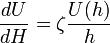
where:
 = speed of the wind at height
 ,
and
,
and
 is a constant
 = exponential coefficient based on ground surface roughness, typically between
0.08 and 0.52
= exponential coefficient based on ground surface roughness, typically between
0.08 and 0.52
 = expected wind gradient at height h
In the 1862 American Civil War Battle of Iuka, an acoustic shadow, believed to have been enhanced by a northeast wind, kept two divisions of Union soldiers out of the battle, because they could not hear the sounds of battle only 10 km (six miles) downwind.
 in m/s.
  in m/s; temperature ϑ in °C