MAKING A MODEL - INTRODUCTION

V. Ryan © 2008


When designing a product there is a time when it is necessary to make a scaled model. This is a useful exercise as it allows the designer to select an idea and make a 3D representation.
Usually a designer will make a number of models starting with quick card models progressing to more detailed scaled models manufactured from more expensive materials. Sometimes specialised modelling materials are used to produce hyper realistic models.

Making a model or range of models is regarded as good industrial practice.


MAKING A COMPUTER MODEL


1. A computer model can be as useful as a 3D model made from actual materials. A CAD drawing can be revolved, sectioned and viewed in a variety of ways.
2. Computer models allow the designer to apply colour and texture very easily change the very nature of the product in seconds.
3. If a potential client is viewing the computer model it can be changed and updated at the time of the meeting / interview.
4. A disadvantage of a computer model is that a computer and software are required.
5. Computer software can be used to calculate the cost of the finished product. For example, crocodile clips software can be used to calculate the cost of components required for a completed circuit. Most CAD software can be used to calculate the volume of materials needed. This means that a project can be costed early in the design process.
6. Spreadsheets can be used to calculate the cost of projects and this is an essential part of project work. Spreadsheets can also be used to model situations and are especially useful for systems and control projects. For instance, spreadsheets can be used to stimulated temperature change within a systems environment.
7. Flow charting software such as that used in crocodile technology allows the programming of a PIC Microcontroller circuit to be stimulated, tested and improved.


SIMPLE EXAMPLES OF WORKING COMPUTER MODELS

MAKING A REALISTIC MATERIALS BASED MODEL

 
1. Making a model allows the designer to physically see the idea in 3D form.
2. It helps the designer identify potential faults and correct them as well as make further improvements.
3. It allows the designer to experiment with a range of materials, eventually selecting the best materials for the chosen design. Sometimes it is a good idea to make a selection of models from a range of materials. This allows the designer to experiment before purchasing expensive materials for the actual manufactured product.
4. It allows a simple evaluation of the design by the designer and potential customers.
5. It is easier to record the views of others by showing them a 3D scaled model rather than a ‘flat 2D’ drawing.
6. A 3D model can be passed around a table of people who form a customer focus group.
   

A Model of a electronically controlled green house is seen below. The circuit monitors the temperature inside the green house and turns on fans to cool the air if the temperature exceeds a set level. The model is manufactured from MDF, compressed polystyrene and other modelling materials.


This is a model / prototype of a game for a young child. It has been constructed accurately including the joints. This is a realistic working model, ready for testing and evaluation by a focus group of potential customers.


MODEL MAKING TOOLS AND EQUIPMENT - 1

V. Ryan © 2008


A craft knife and cutting mat are essential model making tools. They can be used to cut model making foam boards as well as paper and card. A craft knife should always be used with a steel ruler when cutting straight lines, ensuring that hands and fingers are kept behind the cutting edge.

A model maker will inevitably need a selection of scissors to cut shapes. Scissors have the relative advantage of being comparatively safe compared to craft knives. Left handed scissors are useful for left handed people.

A hot wire cutter can be used to shape a variety of model making foams including Styrofoam. This is a specialist model making material easily cut and shaped by a hot wire. Styrofoam can also be cut and shaped with hand tools although less accurately.
Most hot wire cutters have a central wire fixed between two points and a hand held wire cutter. This is useful for free had styling and shaping.

A small bench drill is used to drilling holes and they are cheap to purchase. Always clamp the model making materials down whilst drilling. The usual safety rules apply to the smaller bench sized machines as apply to full size machine drills.

Fretsaws are used when cutting lightweight materials such as MDF, plywood, plastic materials and model making materials such as depron and zepron.

A glue gun can be used to quickly fix materials together. However, the glue can be very hot and so care should be taken when using the gun. Foams tend to melt if glued with a hot glue gun. Test a scrap piece of material first. This type of glue is best used with harder materials.

Glues such as UHU POR or POLY ZAP are amongst the most suitable for foam based boards although balsa glue can be used for balsa wood.
Glue is carefully applied to join all the parts permanently together.


MODEL MAKING TOOLS AND EQUIPMENT - 2

V. Ryan © 2008


Stick / gel glues such as pritt stick are used for gluing card and paper. These are safe and easy to apply.

Spray glues are a really good way to apply glue uniformly to a surface. Surfaces can then be pushed carefully together. The advantage of using this type of spray glue is that the paper / card can be pealed back and repositioned several times before the adhesive properties of the glue disappear.

Photo mount is a stronger form of spray mount and is suitable for photographs or thicker card.

Double sided tape is a semi-permanent method of joining modelling materials. It is very useful when joining plastic and card based materials.

Brass fasteners are very useful when joining modelling card together, especially if movement is needed. This card model below rotates revealing different statements promoting the sale of a particular type of phones. The brass fastener allows this to happen.


MODEL MAKING TOOLS AND EQUIPMENT - 3

V. Ryan © 2008


Epoxy Resin is a two part adhesive. One tube is the glue and the other is the hardener / catalyst. The catalyst speeds up the hardening / drying process. When the two ‘glues’ are mixed together the solution hardens very quickly. This is a permanent glue although it can be quite ‘messy’ to use. It can be used to join almost any material.

Equal lengths of ‘glue’ from each tube are squeezed on to card / scrap material and mixed with a spatula. It should be applied to the surfaces to be glued quickly as it will soon dry/harden.


Tensol cement is a glue suitable for plastics such as perspex. The glue is applied to both surfaces to be joined and then the surfaces are pressed together. If possible the pieces are held under pressure in a vice or clamps. When left for a short time the pieces of perspex will be glued permanently together. The surfaces that come in contact with each other are ‘welded’ / ‘fused’ together.

An effective contact adhesive is Evostik. However, when joining modelling foam such as styrofoam a special contact adhesive is required. Using normal contact adhesive will melt/damage the surface of foam based materials.

A range of modelling paints are available. Water based paints are probably the easiest to use and the brushes can be cleaned very easily with warm soapy water.
Spirit based paints require brush cleaner and sometimes a spirit based paint with damage the surface of modelling materials.

MODEL MAKING TOOLS AND EQUIPMENT - 4

V. Ryan © 2008


A china graph pencil or water based felt pen or even a pencil can be used to mark out model making materials.

A compass cutter is used to cut circles in paper and light card. It can be adjusted to cut a variety of accurate sizes.

A roller cutter is used to cut curves and arcs in paper and card. A cutting mat should be placed below the card and pressure applied to the cutter as it is moved forwards.

Paper cutters are used to cut card and paper very accurately in straight lines. These pieces of equipment are very safe as the rotating cutting disk is positioned inside a housing.
A range of cutters are available but the most effective are the large, high quality versions. Small, lightweight versions are cheap and capable of cutting paper only.

MODELLING MATERIALS - 1

V. Ryan © 2008


Virtually any material can be used for making models. Usually a designer will select the type of materials he/she intends to use for the actual product for manufacturing the model. This will depend on the finish/style that he/she wants or the needs of the client/customer. However, light weight materials are the must suitable for initial models.

Art straws are ideal for making model structures and for testing shapes for strength. They come in a range of colours, shapes and sizes and can be glued or taped together. A good example of a model made from art straws is a model bridge.


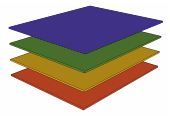
Coloured card is supplied in a range of colours, shades and thicknesses. Card that has different colours on each surface can even be bought . Card is suitable for models especially the early stage of making a series of models.

A good example of card as a modelling material is in the manufacture of a prototype board game.


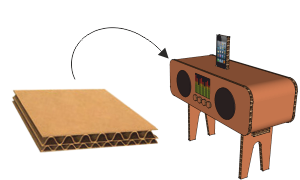
Corrugated card is quite thick and relatively strong. It is used for the manufacture of initial / rough models as it can be cut and shaped easily and is relatively cheap. It can be salvaged from cardboard boxes and sellotaped together to form models.


Foam boards are lightweight and easy to cut and shape. they are ideal for model making although they can be relatively expensive.

Card clad foam board is form with thick card applied to either surface.

Depron is a polystyrene foam, much lighter than balsa wood and can be cut with a sharp blade, sawn with a fine toothed modelling saw or fretsaw with a very fine blade. It can be sanded and smoothed using the usual files and abrasive papers (eg. wet and dry paper).
Glue guns can be used to join depron or zepron although solvent free glues can also be used effectively. Glues such as UHU POR or POLY ZAP are amongst the most suitable.

Water based paints can be used to apply colour and even solvent free markers are suitable.


MODELLING MATERIALS - 2

V. Ryan © 2008


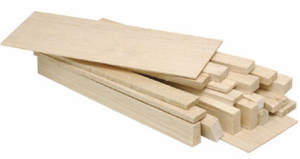
Balsa wood is a traditional model making material. It is ideal for reproductions of wood based projects. Although classified as a hardwood it is very soft and easy to cut and shape. However, it is easily broken or snapped and therefore great care is needed when cutting and shaping.
It can be painted with water based paints and even varnished.


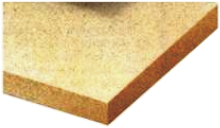
MDF is a cheap option for model making. It is supplied in a range of thicknesses and can be cut and shaped quite easily. It can be painted with water based and spirit based paints. It is recommended that MDF is sealed before spraying with spirit based paints. this can be done cheaply by using diluted PVA.


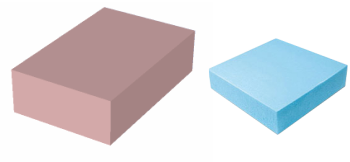
High Density Polystyrene also known as compressed polystyrene is ideal for model making due to its properties. It can be cut and shaped quite easily with fretsaws and even by hand tools. It is supplied in a range of colours, shades and thicknesses.
This type of materials is used for vacuum forming although it is suitable for model making.

Perspex is a good quality plastic material. It is supplied in a range of sections. shapes and sizes. Some of the sections and tubes are expensive to buy although it is suitable for model making. Perspex is supplied in opaque, transparent and translucent form.

Styrofoam is an excellent model making material. It is very light and easy to cut and shape using a hot wire cutter. It can also be shaped with hand tools and files. It can be painted using water based paints (emulsion paints) giving a really good finish.
Using styrofoam requires patience as it can ‘crumble’ at the edges if care is not taken.


SAMPLE MODELS

V. Ryan © 2008


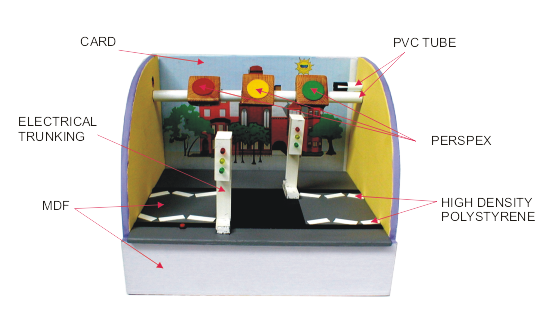
The model below represents an educational toy. It function is to teach young children how to use a pedestrian crossing. A range of materials have been used including perspex, PVC, MDF, card and various parts such as electrical trunking. Much of the materials used have been found in the scrap bin ensuring minimum waste. This model can be regarded as a prototype.

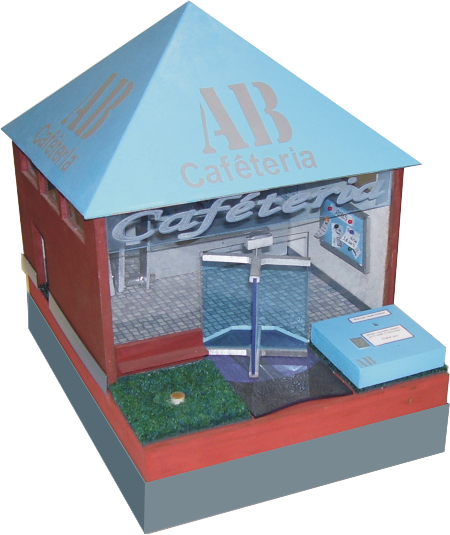
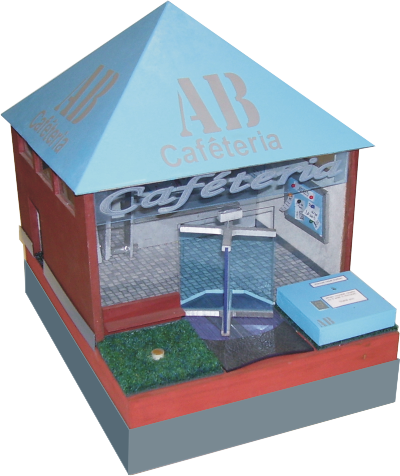
This is a scaled model of a lunch hall. Again the materials have been recycled from the scrap materials bin. A computer controlled router has been used to engrave the shop name ‘Cafeteria’. All aspects of the model work including an electronic circuit that counts customers as they enter and leave the premises. Minor detail has been added including a small noticeboard just inside the rotating door. Patterned lino has been cut to size for the floor for added realism. This is a detailed and well manufactured model.


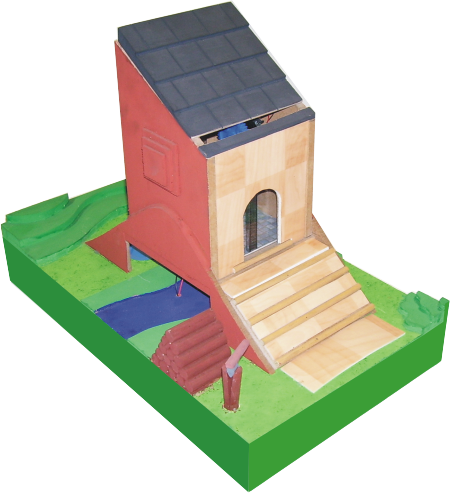
A model of an automatic animal feeder is seen opposite. This has been constructed from a range of materials including perspex, MDF, High density polystyrene. The surfaces have been painted with water based emulsion paints for added realism. Small detail has been included such as the slate effect roof and wood effect material glued on to the front of the feeder.
The feeder works by automatically opening the door at the front, allowing the ‘hamster’ to feed from a dish just inside the door. A microcontroller circuit opens the door to the feeder twice a day.

CARD BASED MODELS

V. Ryan © 2008


The board game below is part of a Graphics project. It has been made from a selection of materials including a variety of coloured card. The packaging is composed of white card and has been sprayed with ordinary spray paint. The lettering has been added by the use of CAD software and a vinyl cutter. A picture has been glued to the lid - this is a colour printout from a typical ink jet printer. Safety symbols have been added including the toy and hobby association symbol and recycling symbol. All appropriate symbols including bar codes are also included. The packaging (lid and base) have been cut from a single sheet of thick card with the fold lines ‘scoured’ with a craft knife. The lid and base have been folded accurately and joined with double sided tape.

The insert to the packaging has been manufactured through vacuum forming of high density polystyrene over a former. The dice have been made from MDF, sprayed with the dots added with a felt pen. A set of instructions has been added. This was printed on good quality card and given a plastic coating with sticky back plastic.

The board game is composed of thick white card. It has coloured paper glued to the surface and graphics added. The board is in four parts held together with reinforcing tape.


This is a very accurate prototype made to the highest possible standards. this could be used with a focus group of potential customers. They could play the game, test out the quality of the materials and make recommendations regarding improvements.


ARCHITECTURAL MODELS

V. Ryan © 2008


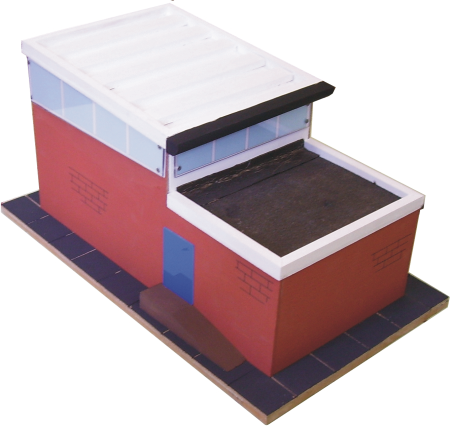
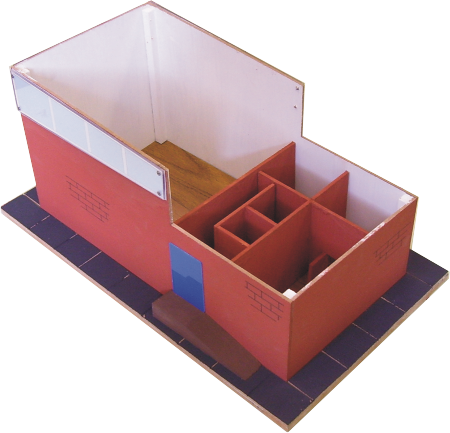
Architectural models are usually made to scale. Their purpose is for the architect to use when showing clients. A model can be disassemble allowing the interior to be seen. The model is usually quite detailed and gives a true reflection of the design. The model can be the focus of discussion between the architect and the client. Modifications to the design can be discussed and changes made at an early stage rather than when the building is taking place.


The photograph below shows a building which incorporates a conference room and a number of smaller rooms suitable for meetings.
The structure of the two roofs can be seen clearly. The model ensures that the client can physically see what the finished building will look like.

The model has been manufactured mainly from MDF and Perspex. Other materials include tarpaulin for the flat roof and water based paints.


The roof of the model has been removed showing the interior. The large conference hall and smaller meeting rooms are seen.

COMPUTER GENERATED MODELS

V. Ryan © 2008


The model below has been generated using CAD (Computer Aided Design) software. The furniture has been drawn individually and placed inside the computer generated room. The room can be rotated to almost every possible angle. This design can be shown to potential customers or a client and changes made according to his/her likes and dislikes. This saves time and money as the model can be altered using the software which is far more efficient than making a real model using materials.

The phone shown below has been designed using the same CAD software. The client (an international communications company) have been asked how they would like it changed so that it is exactly what they want for there retail outlets.

The client representatives have tested the computer model on a selection of potential customers. They have recommended changes and these will be applied to the computer generated image. It will then be tested for a second time before a prototype is manufactured at great expense.

The technologically advanced torch shown below has been modelled so that the internal electronic parts can be seen. Making an actual model to display this type of information would be virtually impossible. However, a computer generated model can be animated to show how the parts fit together. the outer casing can be made to look either transparent or translucent. This would be difficult to achieve and be time consuming if a real model was to be manufactured.

In this case a computer model has major advantages to a real model manufactured from actual materials.

   
Why would a real model take longer to manufacture than creating the same product on CAD software?

What are the advantages of using Computer Aided Design software for modelling?

What are the disadvantages of modelling using computer software in comparison with a real model that can be picked up and handled?


COMPUTER GENERATED SYSTEMS MODEL (SPREADSHEETS)

V. Ryan © 2008


The model dining hall below has been fitted with four temperature sensors. They have installed to detect fire as the temperature will rise quickly when a fire takes hold.


In order to check whether the system has working potential a spreadsheet has been produced that models the system.

Two screen prints are seen below. The first shows sensors one, three and four showing false (no fire). However, the room second sensor reads ‘FIRE’. This warns the security guard who has time to clear the dining hall of any people.


The spreadsheet has been created with formulas. These are seen in the second screen print below. The formula used is very simple. For example sensor two reads the actual temperature in the TEMP row. If it is higher than 90 degrees then the word FALSE is replaced with FIRE. This models the possible real life situation.

The same type of spreadsheet could be applied to calculate the number of people entering the dining hall or be used to calculate stock.


MODELS AND PROTOTYPES - EXAMINATION QUESTION

V. Ryan © 2011


PDF FILE - CLICK HERE FOR PRINTABLE WORKSHEET
 
Companies manufacturing products spend large amounts of money designing and developing their ideas. It makes sense for them to build models / prototypes of a product, before it goes into production. It saves money as faults and improvements can be identified and corrected, before expensive manufacturing on a production line begins.
Models and prototypes are important when discussing a new product with potential customers / clients and focus groups.
   
Large companies such as BMW still make full size clay models, made to look realistic. This helps them to design and develop top class cars.

A full size clay model of a BMW car.
Manufactured to help the designers further develop the car


Explain why modelling and prototyping is important, during the development of a product and the development of ideas/designs. The key words / phrases below, may help you answer this question.
 
TESTING - IDENTIFICATION OF FAULTS - DESIGN IMPROVEMENTS IDENTIFIED - CUSTOMER / CLIENT DISCUSSIONS - SAFETY ISSUES - ASSESSING MATERIALS - EVALUATE FUNCTIONALITY - ASSESSING AESTHETICS - USED WITH FOCUS GROUP SAVES MONEY
 
SAMPLE ANSWER:
 
Model making is an essential part of designing and developing a product. Models can be computer generated or manufactured by hand, to a scale. Models help determine whether an idea is going to work or needs modifying. A model allows early testing of a product, quickly and cheaply.

Simple models made early in the design of a product, can be used to ask potential customers which one they like best. Clients, potential customers and focus groups, can be asked for their views, when looking at a model and improvements made to the design.

Testing models is an excellent way of identifying problems and faults. Safety issues can often be identified and resolved at this stage of model making. Models are often tested to destruction, to ensure that the final product can withstand everyday use.

It makes economic sense, for a company to build models / prototypes of a product, before it goes into production. It saves money as faults and improvements can be identified and corrected, before expensive manufacturing on a production line begins. Compensating customers for faulty goods or recalling faulty products, is extremely expensive and will damage the good name and reputation of a company for years.


WHY MAKE A MODEL ?

V. Ryan © 2001 - 2011

 
PDF FILE - CLICK HERE FOR PRINTABLE WORKSHEET
 

It is always a good idea to make models of your ideas, before deciding on the final design. Models can be computer generated or manufactured by hand, to a scale. This will help you determine whether your idea is going to work or needs modifying. A model allows you to test your solution quickly and cheaply. You could ask your client / customer if the design is what they are looking for?

Imagine the time and money that would be wasted, if a car manufacturer designed and manufactured a new car, without showing a model to potential customers and before a production line was setup. If the car was not popular or was found to have faults, hundreds of millions of pounds would be lost.

The proportions of the product, its functionality, aesthetics and even materials, can be assessed / evaluated by manufacturing an actual model or by producing a CAD model. A model can be used by a focus group or as part of a survey of potential clients, to discuss their views.


TESTING YOUR DESIGNS

 
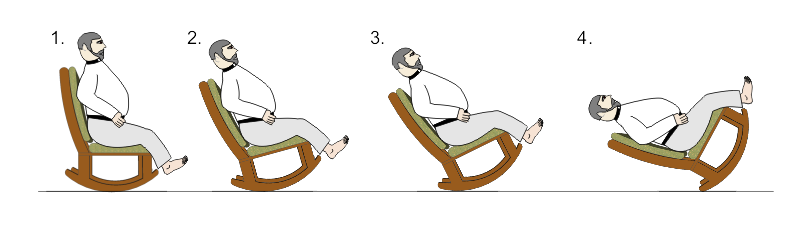
A Model of a Rocking Chair: It is just as important for you to make models and test your ideas on your client / customer. You could make several simple models (perhaps from card) early in the project and ask potential customers which one they like best. This could be presented as a questionnaire (see earlier information sheet).

What will happen if a person leans back in the chair ?

What is the advantage of making this model chair before making the full size version ?


The danger becomes apparent when watching the animation showing the chair being tested.

This could have been avoided if a scaled model had been made and tested.


MODELLING MATERIALS - PLASTICINE

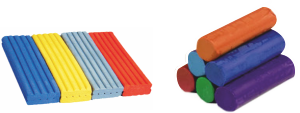
Plasticine is a form of modelling clay. Although normally associated with children, this material is useful in the initial stages of design, when quick model making is important. It can be shaped / moulded by hand and reused. Plasticine comes in a range of colours.


ART STRAWS


Art straws are ideal for making model structures .
They are supplied in a range of colours, shapes and sizes and can be glued or taped together. A good example of a model made from art straws, is a model bridge.

By V.Ryan


COLOURED CARD

Coloured card is supplied in a range of colours, shades and thicknesses. Card that has different colours on the front and back surfaces can even be bought. It is suitable for colourful models, especially the early stages of making a series of models.

A good example of card as a modelling material, is in the manufacture of a prototype board game.

By V.Ryan
 
  CORRUGATED CARD

Corrugated card is quite thick and relatively strong. It is used for the manufacture of initial / rough models, as it can be cut and shaped easily and is relatively cheap. It can be salvaged from cardboard boxes and sellotaped together to form models.

By V.Ryan


CARD CLAD FOAM BOARD

Foam boards are lightweight and easy to cut and shape. It is ideal for model making, although foam board can be relatively expensive.

Card clad foam board is - foam with thick card applied to either surface.

By V.Ryan

It can be cut and shaped easily, using hand tools and light equipment such as fretsaws.
 
  BALSA WOOD

Balsa wood is a traditional model making material. Ideal for model making. Although classified as a hardwood, it is very soft and easy to cut and shape. However, it is easily broken or snapped and therefore great care is needed when cutting and shaping.
It can be painted with water based paints and even varnished.


STYROFOAM

Styrofoam is an excellent model making material. It is very light and easy to cut and shape, using a hot wire cutter. It can also be shaped with hand tools and files. It can be painted using water based paints (emulsion paints) giving a really good finish.
Using styrofoam requires patience, as it can ‘crumble’ at the edges if care is not taken.

By V.Ryan
 
  PVC / HIGH DENSITY POLYSTYRENE

High Density Polystyrene, also known as compressed polystyrene, is ideal for model making due to its physical properties. It can be cut and shaped quite easily with fretsaws and even hand tools. It is supplied in a range of colours, shades and thicknesses.
This type of materials is used for vacuum forming, although it is suitable for model making.