Quality Control is, carrying out regular checks on the production line, as a product is manufactured. Substandard components / products are rejected, ensuring that only products of the correct standard are distributed to the customer / retailer.
THE BRITISH STANDARDS INSTITUTE KITE MARK
AND THE CONFORMITE EUROPEAN SYMBOL
V. Ryan © 2011
| PDF FILE - CLICK HERE FOR PRINTABLE WORKSHEET | |
| WHAT IS THE BRITISH STANDARDS
INSTITUTE? The British Standards Institute is the Authority responsible for setting manufacturing standards for product safety and quality. These are strict standards that products should reach or surpass, in order to be regarded as both safe and manufactured to a consistently high standard. Companies wanting to display the respected British Standards Institute’s Kite Mark, pay to have their product(s) tested against British and International Standards. When a company is registered with the BSI, its manufacturing processes and products are checked frequently, to ensure that the high standards set by the BSI are maintained. |
|
WHAT IS THE BRITISH STANDARDS INSTITUTE KITE MARK?
Products that have a British Standards Institute (BSI) Kite Mark stamped on
them, have been checked for safety and quality of manufacture, by the BSI. The
Institute carries out strict tests, that have been designed to ensure that the
product is safe and has been manufactured to a high standard. The BSI Kite Mark
is respected throughout the world. If a product being tested meet British
Standards, the manufacturer is issued with a licence, allowing the use of the
Kite Mark.
| WHAT IS THE CONFORMITE EUROPEAN SYMBOL? The European Community sets minimum standards of safety and manufacturing quality, that apply across all member countries of the EEC. Manufacturers working to this ‘lowest’ limit, can display the CE symbol on their products. Minimum standards have been established, that apply to a vast range of products, ranging from toys to motor vehicle components. Manufacturers must ensure, that their products at least meet these minimum standards or risk having them removed from the shelves of retailers throughout Europe. |
|
| In Britain, companies applying for a British Standards Kite Mark, usually have their products tested against European Standards as well. If they are successful, they can display both the BSI Kite Mark and the Conformite European Symbol on their products. | |
| HOW DO THE TWO STANDARDS DIFFER? | |
| To achieve
the British Standards Institute Kite Mark, high standards of manufacture,
safety and quality must be reached and maintained. However, the Conformite European Symbol can be applied to products reaching minimum European standards. The BSI Kite Mark requires products or services to achieve consistently high standards, well above the minimum required by the EEC. |
QUALITY ASSURANCE
V. Ryan © 2007
|
The example below shows part of a production line
making expensive alloy tubing. The tubing is manufactured for the
aeronautical industry (aircraft industry) and consequently must be
accurate and precise. Quality Assurance checks have ensured that the
equipment used to manufacture the product, the training of staff, the
selection of quality materials and the manufacturing processes are to the
highest possible standard. Quality Assurance also ensures that the
customer has his/her say. |
|
The level and quality of staff training is assessed by the Quality Assurance Manager. He interviews a selection of the workers and questions them about how they ensure the quality of their own work. |
||
|
|
||
|
Also, he examines samples of work they have completed after attending training courses run by the company. This helps him assess the quality of the training courses and instruction. |
|
|
|
The Quality Assurance Manager ‘spot checks’ the quality of the materials ordered for the production line. He is really interested in the department that orders materials and how they ensure that only the best materials are allowed into the factory and on to the production line. He will interview the staff to ensure that they are constantly checking quality. |
||
QUALITY CONTROL
V. Ryan © 2007
|
The example below shows a production line that makes high quality boomerangs. These are 'batch' produced which means, in this case, that one hundred boomerangs are made as a batch and then sent to the customer. Quality control procedures are in place which means that after every stage of making a Quality Control Officer checks the standard of the work. Any substandard work is recycled or thrown away. |
||
|
The Quality
Control Officer constantly checks that the boomerangs are being made to a
high standard. He patrols the production line and completes a ‘
Certificate of Quality’. This will be included with each boomerang so that
the customer knows that he / she has received a quality product. |
||
|
The final quality check is to test the boomerang in action. If it returns to the Quality Control Officer then it has passed all the tests and can be sent to the customer. |
||
| What is meant by the term Quality Assurance? | |
| Quality Assurance is the term used by manufacturers, to describe the ‘administrative system’ put in place, to ensure that quality control (checks carried out by workers on a product / component) can be carried out effectively. Quality Assurance should ensure that staff training, administrative procedures and quality monitoring of the product at various stages of manufacture, is to the highest standard. Customer surveys will be carried out to ensure customer satisfaction, all part of quality assurance. Furthermore, the British Kite Mark and European CE Mark, may be applied to products that satisfy British and European quality standards. | |
| What is meant by Quality Control? | |
| Quality Control refers to the checks carried out on a product by workers, during stages of its manufacture. These checks may include, simply ensuring that components are positioned correctly, or that they are the correct type and size. A final quality check should include, testing the product to ensure it is to the correct standard, before it is distributed to the retailer / customer. A combination of visual checks and automated checks (by sensors and computers) are usually carried out. | |
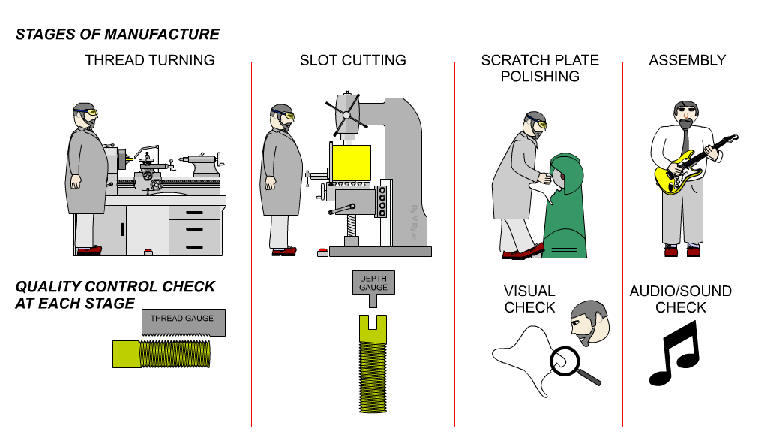
| Example: A guitar is manufactured for a customer. Many stages are involved in the making of the guitar. Four of the stages of manufacture are seen below. Each of the stages includes a quality check, to ensure that substandard components are rejected and that only accurately made components are assembled, to form the final guitar. | |
|
|
|
| How do Quality Control and Quality Assurance differ? | |
| Quality Assurance is the
system of administrative procedures, set up to ensure that effective quality
control on the production line can be carried out. This includes the
training of staff, so that they know how to recognise substandard work /
products. Quality Control is, carrying out regular checks on the production line, as a product is manufactured. Substandard components / products are rejected, ensuring that only products of the correct standard are distributed to the customer / retailer. |
TOLERANCES - 1
V. Ryan © 2007
|
When a product is manufactured in large numbers by batch or continuous production it is almost impossible to ensure that each individually finished product is exactly the same. Each finished product may look the same but there will be very small differences. For example, the boomerang shown below has been manufactured as one in a batch of a thousand. Each boomerang will differ very slightly in its size and shape due to the way it has been manufactured. This is usually the case when manufactured products are made completely by hand or part manufactured by hand. |
||
|
When each boomerang is finished it is checked to ensure that each one is as near to the correct size as possible. Each boomerang must fall between two critical measurements for height and length. The height must fall within measurements ‘A’ and ‘B’ and the length within ‘C’ and ‘D’. This is called ‘tolerance’. Any boomerang falling outside either of these sets of measurements is rejected and recycled. |
||
|
PASS The boomerang below has passed the tolerance check and it is the right size. This means that it works efficiently and accurately. |
||
|
FAIL The boomerang below has failed its tolerance check as its measurements are outside the set limits. When tested the boomerang lacked accuracy and failed to work properly. |
||
|
Checking tolerances is all part of quality control. It is likely that more complicated products will be checked for tolerances several times during manufacture. |
||
TOLERANCES - 2
V. Ryan © 2007
|
Can you imagine if car wheels and tyres were manufactured without checking tolerances (measurements) ? The car below has wheels and tyres that should be exactly the same. However, they were manufactured without tolerance checks being made. As a result the wheels and tyres are slightly different sizes and the car is dangerous as a result. |
||
|
The digital vernier caliper is a very accurate measuring device. It is being used to check that the steel bolt falls within 81mm and 80mm in length . If it is outside these measurements (tolerance) it will be rejected. |
||
|
If the measurement falls between -0.5mm less than 80.50mm or +0.5mm above 80.50mm then the bolt is within tolerance and will not be rejected. Any measurement outside this range and the bolt is rejected. |
||