A standard component is usually
an individual part (called a ‘component’), manufactured in thousands or
millions, to the same specification (such as size, weight, material
etc...). A good example is a steel bolt. Bolts are available in a vast
range of standard sizes. However, each size will be manufactured to an
internationally accepted standard.
For example, a M20 bolt. A typical steel M20 bolt is a specific length,
diameter, quality of steel, pitch of thread etc...
To ensure that each bolt is the same, a small number, are selected from a
batch and checked for quality and tolerance, before being sold to
customers. Each sample bolt must fall within certain tolerances before
being passed.
EXAMPLE TOLERANCE CHECK ON A
M20 BOLT
The digital vernier caliper is
a very accurate measuring device. It is being used to check that the steel
bolt falls within 81mm and 80mm in length . If it is outside these
measurements (tolerance) it will be rejected.
If the measurement falls
between -0.5mm less than 80.50mm or +0.5mm above 80.50mm, then the bolt is
within tolerance and will not be rejected. Any measurement outside this
range and the bolt is rejected.
EXAMPLE TOLERANCE CHECK ON A
STANDARD RESISTOR
Resistors are
manufactured in their millions each week, to strict standards. It is
impossible to check each one individually. Consequently, the quality of a
small number is checked, for every batch produced.
The diagram opposite shows a tolerance check on a resistor. A multimeter is
used to check that the resistance of the resistor falls within a lower and
upper resistance level. This simple check will usually identify faulty
batches of standard resistors.
Simple checks should ensure that all the resistors have been manufactured to
the same standard.
Consequently, manufacturers of electrical products such as TVs, should be
confident that they are buying a quality standard component, even if it is
only a resistor. It could take only one faulty or substandard component to
prevent a product such as a TV from working properly.
WHY USE STANDARD COMPONENTS WHEN
DESIGNING
AND MANUFACTURING?
In industry, very
little could be manufactured by mass production, without a supply of
standard components. The fact that standard components are available,
means that many of the products we buy and use today, can be manufactured
in their thousands / millions, ready for consumers.
Take for example, the mobile phone. There are hundreds of components
inside a typical mobile phone. Some of these components are used in all
mobile phones (regardless of the manufacturer - Samsung, Nokia, Blackberry
etc...) and in other electronic products. Electronic components, such as
resistors, transistors, integrated circuits (ICs) and many more, are
supplied by electronics manufacturers, in their millions, to mobile phone
manufacturers. Each mobile phone manufacturer has a model, with a range of
features and functions. These companies assemble standard components to
form their own unique product. Mobile phone companies also have their own
specialised components, these are also manufactured to a standard size /
voltage / tolerance etc... so that they can be used across a range of
their phones.
Electronic component
manufacturers, manufacture diodes, resistors, capacitors and transistors to
standard sizes and standard electrical specifications. Although hundreds of
different resistors are available (300R, 1K, 1M etc...), they are all
manufactured to a specification / written standard, allowing customers to
choose the ‘value’ and dimensions of the components they require. This
applies to most electronic components.
Transistors were developed first
in the 1960s and are now found in virtually every electronic device.
Although there are thousands of different types of transistors, they can be
regarded as a standard component. Transistors are found in any device
relying on an Integrated Circuit (IC). For example, radios, phones,
computers and control circuits in microwaves, cookers, washing machines
etc.....
Security alarm manufacturers use
standard electronic components to produce their own ‘alarm’ products.
Without the supply of standard components, products such as these would be
simpler, less sophisticated, much more expensive and less reliable.
TV manufacturers, computer
manufacturers and mobile phone manufacturers, order the components they
need, with the knowledge that they have been manufactured to a strict
standard. This allows manufacturers to design their own, more complex
products, that can be manufactured in thousands or even millions, assembled
from standard components.
Car manufacturers, assemble
thousands of cars every week, with most cars composed of standard
components. Car manufacturers, such as Volvo, Ford and Nissan use many of
the same components. This includes, windscreen wipers, bulbs, brake pads,
electronic systems and even satellite navigation systems. All are standard
components. The use of standard components, allows manufacturers to keep the
cost of individual cars as low as possible. It also ensures that quality is
maintained.
THE CONSTRUCTION INDUSTRY - AND STANDARD COMPONENTS
Materials, ranging from woods
and steels to plastics, are supplied in standard sizes. Designers /
architects generally start with standard widths, lengths and depths etc...
and develop their plans from the materials that are available. As
materials are supplied in standard sizes, ordering is easier, as sizes are
published in catalogues or on company internet websites.
Buildings are usually constructed from materials supplied as standard
sizes(bricks, timber, glass). It is rare for a building to be built from
non-standard/individual sizes, unless it is an individual, innovative
design.
The German designed and built
‘Huf Haus’ is an excellent example of component based house construction.
THE ‘HUF HAUS’
The Huf Haus is a Prefabricated
House, built in the factory as a flat pack and reassembled on site. This
type of house is built on an industrial scale.
The design was inspired by the Bauhaus designers of the 1920s, who
approached design through functionality and simplicity, combined with
aesthetics. With the Huf Haus, emphasis is placed modern design and a
distinctive style. Each house is constructed from standardised components
and are essentially a beam and post structure. The beams form the framework
on to which all other components are fitted. There are no internal weight
bearing walls to restrict the internal layout. This frees up internal space,
so that there are a variety of layouts. The emphasis on glass, is another
distinctive feature of modernist buildings.
Although these houses are built from standardised components (another
feature of modernist design), architects ensure that every house is
different and individual. The basic structure of every house is the same,
but each house is designed to fit its environment and this varies, depending
on the location.
Distinctive wooden beams form the
main structure. The wall panels are designed to fit together when they
arrive on site. Standard fittings are used on all the Huf Haus designs. The
wall panels have a series of pipes and cavities, that will eventually
carried electrical wiring or pipes for plumbing/heating. Another distinctive
feature of this style of house, are the large double or treble glazed
windows (often seen in modernist buildings) .
Using standard, factory built
components has one major advantage, when the building is being assembled on
site. It only takes about a week for the major construction work to be
completed.
FITTINGS AND FIXINGS
Fixings including nails, screws,
nuts and bolts are manufactured to exact standards (sizes). This allows
furniture manufacturers and the construction industry to purchase fixings in
large numbers, with the knowledge that all the fixings are exactly the same.
This speeds up 'construction', as standard sizes of materials are combined
with standard fixings, producing the final product.
PIC microcontrollers (
Programmable Interface Controllers), are pre-built electronic circuits,
that can be programmed to carry out a vast range of tasks. They can be
programmed to be timers or to control a production line and much more.
They are found in most electronic devices such as alarm systems, computer
control systems, mobile phones, in fact almost any electronic device. Many
types of PIC microcontrollers exist, although the best are probably found
in the GENIE range of programmable microcontrollers. These are programmed
and simulated by Circuit Wizard software.
Although PIC Microcontrollers are composed of many individual standard
electronic components, they can be regarded as a complex standard
component in their own right. This is because they have numerous practical
applications when used as a programmable circuit. PIC Microcontroller
circuits are purchased by manufacturers and used as standard ‘components’
in even more complex products.
PIC Microcontrollers are relatively cheap and can be bought as pre-built
circuits or as kits that can be assembled by the user.
A standard PIC Microcontroller
circuit, with basic inputs and outputs connected.
SOME USES OF PIC
MICRO-CONTROLLERS
They are standard programmable
circuits but can be used;
In alarm and security systems,
to control production lines,
to control individual machines, on a production line,
to monitor and control engines,
to monitor sensors and to turn on outputs,
in communication systems,
in domestic central heating systems,
In numerous devices in the kitchen
HISTORICAL BACKGROUND TO THE
DEVELOPMENT OF STANDARD COMPONENTS
Pre-industrial society was a
world without standard components. Industrial progress was slow, and life
was much harder for the vast majority of people.
Industry was based on making hand crafted items, requiring individual
craft skills. Skilled workers developed their craft skills over years and
decades. Even nails and screws were made by individual craftsmen, to their
own standard (size and shape). Consequently, manufactured products were
very expensive, and usually out of reach of the average citizen.
Everyday products were relatively simple, as each product was manufactured
in its entirety in the same small factory. Factories tended to be small,
relying on in-house designers and manufactured every part of the product
they were producing.
During the Industrial Revolution, standard components were introduced and
industrial progress accelerated, slowly benefiting society. Standard
components are the building blocks of more complex products. During the
age of steam, fittings such as screws, bolts, rivets were manufactured on
an industrial scale, to standard sizes. Also, steel and other materials
were made to standard sizes and quality. This helped in the design and
manufacture of more complex devices such as boilers, leading to rapid
industrial progress. This lead to the age of steam.
During the 1950s and 1960s, the electronics industry developed. The use of
standard electronic components made it possible for consumer products to
be mass manufactured. Our modern consumer society began to take shape.
Today, products ranging from electronic gadgets and domestic appliances to
cars, all depend on the assembly of standard components. Our communication
system and transport system depend on standard components. Without
standard components and resulting assembled devices/appliances, almost
every aspect of our lives would be much harder and less fulfilling.
ADVANTAGES OF STANDARD COMPONENTS
1. Standard components can be
manufactured in vast quantities, keeping costs down. For example, several
manufacturers supply steel screws/bolts at standard sizes. This
'competition' helps to keep prices low and offers customers a choice of
supplier. Also, the manufacturers have to maintain the quality of their
components, if they are to attract customers.
2. Standard components are supplied in standard sizes. Consequently, they
are easy to order. Ordering standard components is relatively
straightforward, as sizes / dimensions etc... are available in table or
index form.
3. Buying directly from suppliers, over the counter, at hardware stores such
as B & Q, is easier as standard components such as screws, bolts, nails and
fixings are often displayed in order. This makes it easier to find the
component the customer requires.
4. Safety / quality testing is easier when dealing with standard components.
Often a number of standard components, from a batch will be tested. As they
are all the same, it is not necessary to test each component individually.
Faults can be identified and corrected quickly. Faulty components if
detected, can be withdrawn from sale.
5. Manufacturers of ‘complex’ products (computers TVs, etc....), usually
assemble their products from standard components. This allows them to
concentrate on the development of their specialised product, rather than
having to design each individual component. This speeds up product
development.
6. Setting up a mass production line is easier, if standard components are
used. It is easier to train staff / the workforce, as they are dealing with
the same standard components, when assembling products.
Product Designers are usually
asked to develop an existing design, rather than to design a new product
from scratch. Updating successful or even unsuccessful designs is a
regular occurrence in the working life of a Product Designer.
Take for example the humble and tried and tested pen knife. The existing
design, as seen with the Swiss Army Knife, has evolved slowly over many
years. Pen knifes and multifunction knives have been used for well over a
century. Even the Romans developed multifunctional tools. Manufacturers
know from experience, that they must continue to develop new designs in
order to remain successful and to continue to sell their products.
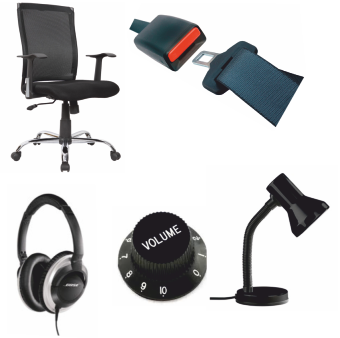
Many products are designed with
adjustment in mind. For example, the computer / office chair seen below.
The chair can be adjusted in terms of its height, so that it can be used
by children and adults.
ADVANTAGES OF THE ADJUSTABLE
OFFICE CHAIR
1. The chair can be used by a
wide range of users.
2. It can be sold to wider range of users, compared to a chair with a
fixed height. The target market is larger and consequently potential sales
are greater.
3. Adjusting the height of the chair to suit the user, makes it more
comfortable to sit on, especially for long periods of time. It is
ergonomically designed.
4. The height and swivel adjustment means that it conforms to Health and
Safety guidance. These features help reduce possible repetitive strain
injury to the user. For example, a bad back or neck strain is less likely
when sat in an adjustable office chair..
5. A comfortable chair encourages the user to work harder. In business,
this is good for productivity.
ADJUSTABLE CAR WING MIRROR
A device as simple as a
car wing mirror, can be adjusted in a number of directions (up, down, left
and right). This means it has many settings and can be adjusted to suit
numerous users of varying heights. (see diagram below).
An adjustable mirror is an essential safety feature, preventing accidents
everyday. Although a small, cheap part of any car, the adjustable wing
mirror plays a major role, helping the driver control his/her car. It offers
vision to the rear and sides of the car.
ADJUSTABLE TROLLEY
The trolley seen below, is
extremely useful when moving heavy items, over a distance.
1. It’s handle is adjustable, allowing people of different heights to use it
comfortably, preventing injury.
2. It acts as an adjustable lever, helping the user to lift increasingly
heavier weights.
3. The trolley can be reduced in height and the shelf folded away, allowing
storage in a confined space such as a cupboard.
Hi-TECH ELECTRONIC DEVICES - THE
iPOD TOUCH
Electronic gadgets such as
the ‘iPod touch’, have a range of adjustments, which can be set according to
the users needs. These include volume, + and - zoom, contrast, brightness
and many more.
These adjustable features are accessed through a touch screen. This means
that the iPod can be operated by almost all age groups.
The iPod touch is an excellent example of advanced technology making a
product easier to use. Electronic devices previously needed a number of
buttons and dials, in order to make adjustments.
Advanced technology has made making adjustments and altering settings, very
simple.
SUMMARY
Building ‘adjustability’ into a
product has the following general advantages:
1. A wider range of people (potential customers) can use the product.
(Office chair, iPod touch, trolley, wing mirror).
2. Products that can be adjusted, are usually more comfortable to use. They
are designed with ergonomics in mind.(Office chair).
3. Adjustable products are sometimes safer to use. (Trolley)
4. Adjustable products are often more efficient, increasing workforce
efficiency. (Office chair, touch screen computers).
5. Some adjustable products have been developed, to ensure that they meet
Health and Safety guidelines. (Office chair).
6. Adjustable products can be more complex than ‘fixed’ alternatives.
7. Electronic products with adjustable features, are now easy to use because
of advances in technology and materials. (iPod touch).
ADJUSTABLE PRODUCTS
Many products are designed so that they are adjustable. A selection are
shown below.
WHY ARE
SOME PRODUCTS ADJUSTABLE?
1. The product can be used by a wide range of users.
2. It can be sold to more customers.
3. The product will be more comfortable to use because it can be adjusted.
4. Health and safety issues are reduced. E.G. a table with height adjustment
will reduce the possibility of back pain.
5. The same product can have multiple users, as it can be adjusted to suit
all their needs.
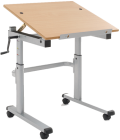
An adjustable table can be set to different heights
AN
ADJUSTABLE OFFICE CHAIR
This office chair can be adjusted in many ways to suit a range of potential
users.
The seat can be raised and lowered.
The angle and height of the back can be adjusted.
Arm rests can be adjusted by height.
The wheels allow for comfortable movement.
Including adjustments to this chair has ensured that it is suitable to a
wide range of people. This is called ‘inclusive design’.
An iconic design is usually a
design that is ‘ground breaking’ and one that sets new standards in its
field. It is a design that other designers and manufacturers follow, as it
becomes a bench mark for other similar products. Furthermore, an iconic
design is one that stands up to the test of time, remaining a good design,
despite the passing of years, decades and even centuries.
The BBC carried out a survey in which British people were asked which
British designs they believed were iconic designs. Amongst the designs
named as iconic were:
Red telephone boxes, red double decker buses, the Spitfire, Concorde, the
Mini car, and the London Underground map.
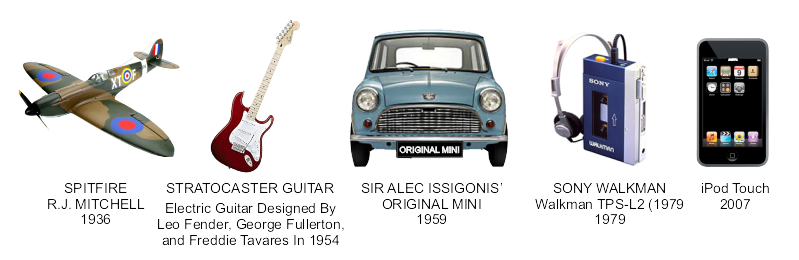
A SELECTION OF INTERNATIONAL
DESIGN ICONS
This is only a very small
selection of recognised iconic designs. Each one was innovative in the way
it was engineered and in the way it solved a design problem. Each was
ground breaking in the features and functions it offered. Each is an icon
of its time/decade.
CRITERIA USED TO DEFINE ICONIC
DESIGN
A simplified criteria which may
help describe or determine, which designs are iconic is written below. Some
or all of these points, can be applied to iconic designs.
A design that sets a bench mark
for others to follow.
A ground breaking design, in terms of its technology or manufacturing
techniques used during its production.
A design that improves on the past.
A design that sets new standards in terms of quality, functions/features or
style.
A design that stands the test of time, remaining popular despite the passing
of years.
A design that stays in the memory of those who see/use it.
A design that is often recognised immediately by consumers.
A design that inspires other designers.
Sets a trend.
A design that is innovative.
A design that is aesthetically pleasing.
A design that is often emulated/copied by other designers.
A design that has its place in history, or even helps change history.
Other international iconic
designs could include; the iPhone, Harley Davidson motorbikes, Rolls Royce
cars, OXO Cubes, Hovercraft, Sony Personal Stereo, Jumbo Jet, Concorde,
Harrier Jump Jet and many more.
The Austin Mini, first rolled off the production line in 1959 and was the
brain child of Alexander Arnold Constantine Issigonis. It was manufactured
by the British Motor Company and was developed as a result of the shortage
of petrol during and after the Suez crisis of the 1950s. It had a
production run of 5.3 million cars and was the best selling British car,
between 1959 to 2000. During the 1960s it became popular with celebrities
and was seen in films and on TV across the world, ensuring that it became
design icon. One of its most famous appearances was in the film ‘The
Italian Job’, driven by actors including Michael Cane.
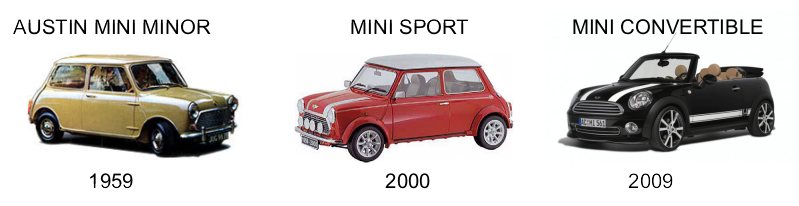
The MINI brand is now owned by BMW and they have produced a series of
modern versions of the Mini, also proving to be popular.
A STYLE BENCH MARK:
The style / shape has evolved, but remains essentially the same. It is still
a small car with similar curves and lines as the original 1959 car, although
a slightly larger version. When comparing the sketches of the 1959 and 2010
Mini cars, the distinct shape of the Mini can be clearly seen. The 1959
‘stocky’ appearance is still apparent in the 2010 model, despite decades of
development. BMW have tried to keep to the original format when styling the
car.
A BENCH MARK FOR OTHER
MANUFACTURERS:
The Mini has set the bench mark of good design, in terms of style and
engineering innovation, for similar cars produced by other manufacturers.
There have been many attempts to emulate the style of the mini and its space
saving features. The two sketches below, show the BMW Mini and the Suzuki
Swift. The Suzuki Swift is a similar size and shape, clearly aimed at
attracting the same customer type. They are competing in the same ‘small
car’ market This emphasises the way in which the Mini has determined design
trends amongst other manufacturers.
TECHNICAL
INNOVATION:
Throughout its evolution, the Mini was at the forefront of design and
engineering innovation. It was the first small car to have front wheel drive
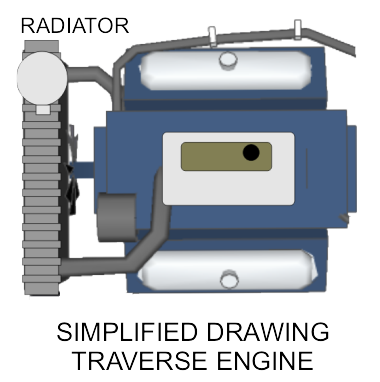
and had small 10 inch wheels. It had a traverse engine, which saved space
and allowed a reasonable sized engine to fit into a small engine cavity. The
sump was designed so that the same engine oil also lubricated the gears
system. The radiator was on the left side of the engine cavity, again saving
space.
The mini had a suspension system based on rubber cones, not conventional
springs. This saved further space, allowing the car to be lower down than
other similar cars of its day. Sliding windows were a feature developed with
this small car in mind. This innovative design meant that storage space was
available in the doors.
The Mini remains popular due to
it iconic status as a fashionable, trendy, small, innovative, stylish car.
SUMMARY
The original Mini design and subsequent designs have set the bench mark for
other ‘compact’ car manufacturers to follow.
Ground breaking engineering and technology was developed during its design and
manufacture, which continues today.
The original Mini was an improvement on previous ‘small’ car design.
The original Mini set new standards in terms of the features it offered and its
style, especially with the more expensive deluxe models.
The Mini brand has stood the test of time, with modern BMW versions being as
popular as early models.
The Mini design is instantaneously recognisable.
The Mini design has inspired other manufacturers to design their own small cars,
some even look similar.
Mini designs remain aesthetically pleasing, despite the passing of decades.