Dies and its Types:
Die:
The die may be defined as the female part of a complete tool for producing
work in a press. It is also referred to a complete tool consists of a pair of
mating members for producing work in a press.
Types of dies:
The dies may be classified according to the type of press operation and
according to the method of operation.
(A): According to type of press operation:
According to this criterion , the dies may be classified as cutting dies and
forming dies.
1: Cutting Dies:
These dies are used to cut the metal. They utilize the cutting or shearing
action. The common cutting dies are : blanking dies , perforating dies ,
notching dies , trimming , shaving and nibbling dies.
2: Forming Dies:
These dies change the appearance of the blank without removing any stock.
Theses dies include bending, drawing and squeezing dies etc.
(B) According to the method of operation:
According to this criterion, the dies may be classified as : single operation
or simple dies , compound dies , combination dies , progressive dies ,
transfer dies and multiple dies.
1: Simple Dies:
Simple dies or single action dies perform single operation for each stroke of
the press slide. The operation may be one of the operation listed under
cutting or forming dies.
2: Compound Dies:
In these dies, two or more operations may be performed at one station. Such
dies are considered as cutting tools since, only cutting operations are
carried out. Figure shows a simple compound die in which a washer is made by
one stroke of the press. The washer is produced by simulation blanking and
piercing operations. Compound dies are more accurate and economical in
production as compared to single operation dies.
3: Combination Dies:
In this die also , more than one operation may be performed at one station. It
is difficult from compound die in that in this die, a cutting operation is
combined with a bending or drawing operation, due to that it is called
combination die.
4: Progressive Dies:
A progressive or follow on die has a series of operations. At each station ,
an operation is performed on a work piece during a stroke of the press.
Between stroke the piece in the metal strip is transferred to the next
station. A finished work piece is made at each stroke of the press. While the
piercing punch cuts a hole in the stroke , the blanking punch blanks out a
portion of the metal in which a hole had been pierced at a previous station.
Thus after the first stroke , when only a hole will be punched , each stroke
of the press produces a finished washer.
6: Transfer Dies:
Unlike the progressive dies where the stroke is fed progressively from one
station to another. In transfer dies the already cut blanks are fed
mechanically from one station to other station.
7: Multiple Dies:
Multiple or gang dies produce two or more work piece at each stroke of the
press. A gang or number of simple dies and punches are ganged together to
produced two or more parts at each stoke of the press.
Terminology used in dies:
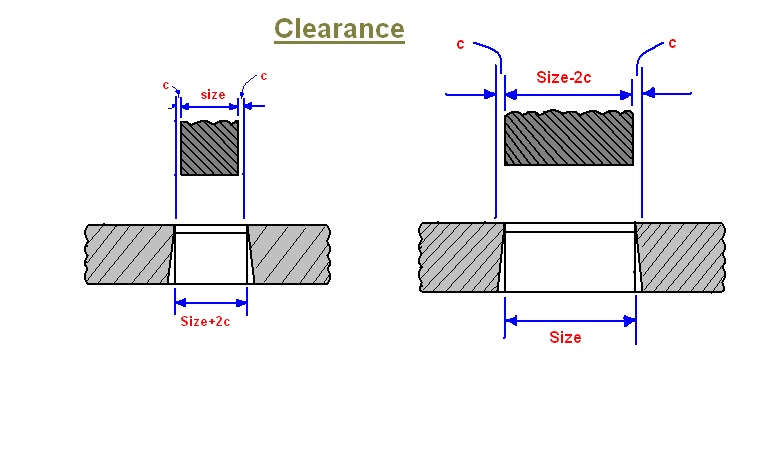
1: Clearance
The difference in dimensions between the mating members of a die set is called
clearance. This clearance is applied in following manner:
1: when the hole has to be held to size i.e. the hole in the sheet metal is to
be accurate (punching operation) , and slug is to be discarded. The punch is
made to the size of the hole and the die opening size is obtained by adding
clearance to the punch size.
2: In blanking operation , where the slug or blank is the desired part and has
to be held to size, the die opening size equals the blank size and the punch
size is obtained by subtract.
2: Cutting Forces
In cutting operation, as the punch in its downward movement enters the
material, it need not penetrate the thickness of the stock in the order to
offset complete rupture of the part. The distance which the punch enters into
the work material to cause rupture to take place is called penetrable and is
usually given as the %age of the stock thickness
The percent penetration depends on the material being cut and also on the
stock thickness. When hard and strong material is being cut ,a very little
penetration of the punch is necessary to cause feature. With soft material the
penetration will be greater.
3: Strippers:
After a blank has been cut by the punch on its downward stroke, the scrap
strip has the tendency to expand. On the return stroke of the punch the scrap
strip has the tin deny to adhere to the punch and be lifted by it. This action
interface with the feeding of the stroke through the die and some device must
be used to strip the scrap material from the punch as it clears up the die
block. Such a device is called “stripper” or stripper plate.
Stripper plate are of two types:
1: fixed or stationary
2: spring loaded or movable
(a): fixed or stationary strippers:
This stripper is attached at a fixed height over the die block. The height
should be sufficient to permit the sheet metal to be fed freely between the
upper die surface and the under surface of the stripper plate. The stripper
plate thickness is determining by the formula:
Ts =1/8(w/3+16t)
Where w and t are width and thickness of the stock strip. The fixed stripper
is also known as ‘channel stripper”
(b): Spring loaded Stripper:
This type is used on large blanking operations and also on very thin and
highly ductile materials. As the punch travels downward for blanking operation
the stripping force is determined with the help of following relation. Fs=spt
kn
Where p and t are in mm and s is the stripping constant.
4:Pilots:-
Pilots are used in progressive dies. In the design of progressive dies, the
first step is to establish the sequence of operations. In this sequence , the
piercing operations are placed first. After the holes have been pierced ,
these holes are used for piloting the blanking punches so that the blank
formed is truly concentric to the already punched hole. This piloting is
achieved by means of pilots secured under the blanking punch. To be effective
the pilot must be strong enough to align the stock without bending. Pilots are
made of good grade of tool steel heat treated to maximum toughness and to a
hardness of 56 to 60 Rockwell C.
Types of pilots: there are two types of pilots:
(a ): Direct pilot:
Pilots which are mounted on the face of a punch are called direct pilots. The
pilot holder is generally a block of steel which can be fastened to the punch
holder.
(b) Indirect pilot:
Such pilots are well guided through the hardened bushes in the stripper plate.
5: Stock Stop:
The strip of sheet metal is fed and guided through a slot in the stock guide
or through a slot in the stripper plate after each blanking. The strip has to
be advanced a correct distance, the device used to achieve this is called “
stock stop”