Drill or Drilling operation:
Drilling is the process of cutting or originating a round hole from the solid
material. There are many ways of classifying drills. The tool(drill) and not
the work piece is revolved and is fed into the material along its axis.
For example , according to material, number and types of flutes, drill size ,
type of shank(straight or taper) and cutting point geometry etc. However the
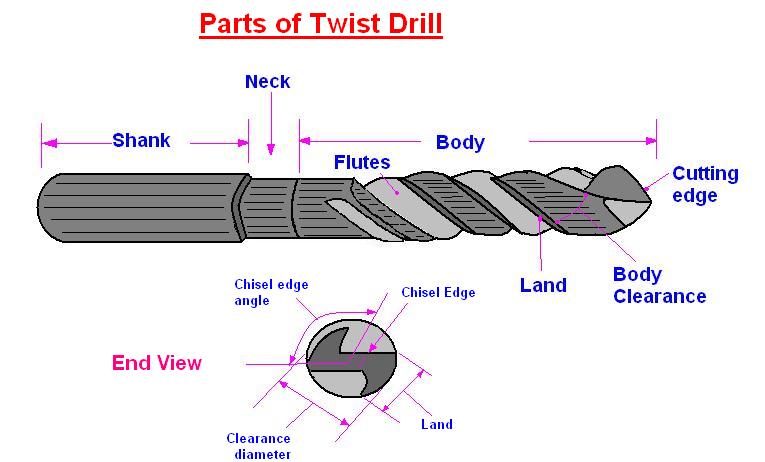
most common type of drill is the fluted drill shown in figure.
It is made from a round bar of tool material , and has three principles parts:
the point, the body and the shank. The drill is held and rotated by its shank.
The point comprises the cutting elements while the body guides the drill in
the operation. The body of the drill has two helical grooves called “ flutes”.
The flutes from the cutting surface and also assist in removing chips out of
the drilled hole. The parts of twist drill are:
1: point:
The point is the cone shaped end and it does the cutting. It consists of the
following:
<!--[if !supportLists]-->(A) <!--[endif]-->dead
center: It is the sharp edge at the extreme tip of the drill. This should
always be the exact center of the drill.
<!--[if !supportLists]-->(B) <!--[endif]-->Lips:
these are the cutting edges of the drill.
<!--[if !supportLists]-->(C) <!--[endif]-->Heel
: It is the portion of the point back from the cutting edge.
2: Shank :
It is the portion of the drill by which it is clamped in the spindle. The
shank may be either straight or tapered. Straight shank drills are used with a
chuck. Tapered shank drills have self-holding tapes that fit directly into the
drill press spindle. On the taper shank is the another term is used which is
called tang. This fits into a slot in the spindles sleeve.
3: Body :
It is the portion between the point and the shank. The body consists of the
following parts:
<!--[if !supportLists]-->(A) <!--[endif]-->Flutes
:
Two or more spiral grooves that run the length of the drill body are called
flutes. The flutes do four thing.
<!--[if !supportLists]-->· <!--[endif]-->Help
from the cutting edge of the drill point.
<!--[if !supportLists]-->· <!--[endif]-->Curl
the chip tightly for easier removal.
<!--[if !supportLists]-->· <!--[endif]-->From
channels through which chips can escape from the hole being drilled.
<!--[if !supportLists]-->· <!--[endif]-->Allow
the coolant and lubricant to get down to the cutting edge.
<!--[if !supportLists]-->(B) <!--[endif]-->Margin
It is the narrow strip extending back the entire length of the flute. It is
the full diameter of the drill.
<!--[if !supportLists]-->(C) <!--[endif]-->Body
Clearance:
It is the part of the drill body that has been reduced in order to cut down
friction between the drill and the wall of the hole.
Drilling Jigs:
Drilling jigs are used to machine holes in mechanical products to obtain
positional accuracy of the holes harden drill bushes or jig bushes are used to
locate and guide drills and reamers etc. In relation to the work piece these
guide bushes are not essential but these prove to be economical and
technically desirable. The position of the jig into which the harden bushes
are fitted is called bush plate. Drilling jigs are either clamped to the work
piece in which holes are to be drilled or the work piece is housed and clamped
in the jig body. If more than one hole is to be drilled , the drill jig is
made to slide on the table to drilling machine. Such a drill jig is moved by
hand into position under the drill so that the drill radially enters the bush.
During the drilling operation the jig is held by hand. If the drill size is
large enough to produce a high torque , either stops should be provided or the
drill jig is clamped to the table of the drilling machine. A drill jig is
provided with feet which rest or slide on the table of drilling machine. These
feet should be outside of the cutting forces, thus providing solid support.
Drilling jigs make pysible the drilling of holes at higher speed with greater
accuracy and with less skilled worker. Then is possible when the holes are
laid out and drill by hand. Also they produce inter changeable parts because
each part drilled in a drilling jig should have the same hole pattern as every
other parts.
It is clear that during the drilling operations burs will be produced. The bur
produced at the short of the hole is smaller than that produced at the end of
the hole. The first type is called minor burs and second type is called major
burr. (when the drill makes through the material). When designing a drill jig
these two types of burr should be taken into consideration since they may
cause difficulty in unloading the work piece from the jig after a hole has
been drilled.
Types Of Drilling Jigs:
Drilling jigs may be classified as follows:
1. Template jig
2. plate type jig
3. Open type jig
4. Channel jig
5. Leaf Jig
6. Box type jig
1: Template Jig:
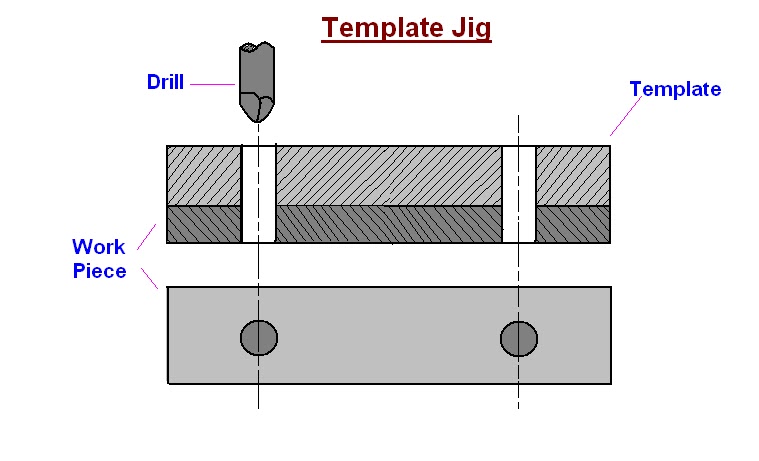
This is the simplest type of jig; It is simply a plate made to the shape and
size of the work piece; with the require number of holes made it. It is placed
on the work piece and the hole will be made by the drill; which will be guided
through the holes in the template plate should be hardened to avoid its
frequent replacement This type of jig is suitable if only a few part are to be
made.
2: Plate Type Jig:
This is an improvement of the template type of jig. In place of simple holes,
drill bushes are provided in the plate to guide the drill. The work piece can
be clamped to the plate and holes can be drilled. The plate jig are employed
to drill holes in large parts, maintaining accurate spacing with each other.
3:Open Type Jig:
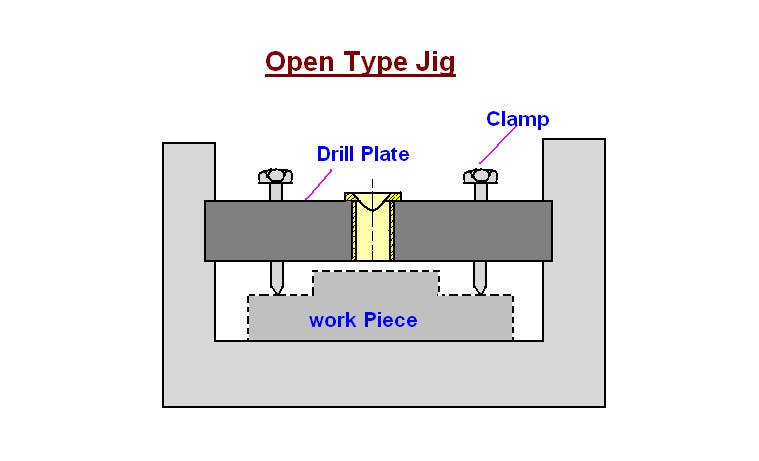
In this jig the top of the jig is open; the work piece is placed on the top.
4 Channel jig;
The channel jig is a simple type of jig having channel like cross section. The
component is fitted within the channel is located and clamped by locating the
knob. The tool is guided through the drill bush.
5: Leaf Jig:
It is also a sort of open type jig , in which the top plate is arrange to
swing about a fulcrum point , so that it is completely clears the jig for easy
loading and unloading of the work piece. The drill bushes are fitted into the
plates , which is also known as leaf , latch or lid.
6: Box Type Jig:
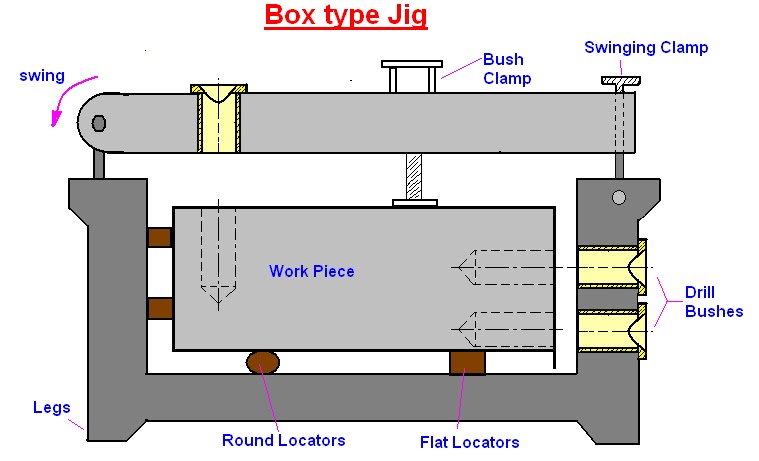
When the holes are to drill more than one plane of the work piece , the jig
has to be provided with equalant number of bush plates. For positioning jig on
the machine table feet have to be provided opposite each drilling bush plate.
One side of the jig will be provided with a swinging leaf for loading and
unloading the work piece, such a jig would take the form of a box. Such a jig
should be as light as possible. Since it will have lifted again and again.
Typical figure of box type jig is shown: