Forging and its types
Forging is the operation where the metal is heated and then a force is applied
to manipulates the metals in such a way that the required final shape is
obtained. Forging is generally a hot working process through cold forging is
used sometimes.
Type of forging
1. smith forging
2. drop forging
3. press forging
4. machine forging
1: Smith forging
This is the traditional forging operation done openly or in-openly dies by the
village black smith or modern shop floor by manual hammering or by the power
hammer. The process involves heating the stock in the black smith hearth and
then beating it over the anvil. To get the desire shape the operator has to
manipulate the component in between the blows.
The types of operation available are fullering, flattering, bending ,
upsetting and swaging.
2: Drop forging
Basic definition:
This is the operation done in closed impression dies by means drop hammer here
the force for shaping the component is applied in a series of blows.
Drop forging utilizes a closed impression die to obtain the desire shape of
the component , the shaping is done by the repeated hammering given to the
material in the die cavity. The equipment use for delivering for blows are
called drop hammers. The drop forging die consists of two halves. The lower
halve of the die is fixed to the anvil of the machine , while the upper halve
is fixed to ram. The heated stock is kept in the lower die, while the ram
delivers 4-5 blows on the metal spreads and completely fills in the die
cavity. When the two die of halves closed the complete is formed. The typical
products obtained in drop forging are cranks, crank shaft, connecting rods,
wrench, crane hooks etc. The types of operations are fullering, edging,
bending, blocking , finishing and trimming etc.
3: Press forging
Similar to the drop forging , the press forging is also done in closed
impression dies with the expectation that the force is continuous squeezing
type applied by the hydraulic press. Press forging dies are similar to drop
forging dies as also the process in press forging, the metal is shaped not by
means of a series of blows as in drop forging , but by means of a single
continuous squeezing action. This squeezing is obtained by means of hydraulic
presses. Because of the continuous action of by hydraulic presses, the
material gets uniformly deform through out its entire depth ,the press forging
dies with the various impression , such as fuller, bender and finisher
impression properly arranged .
4: Machine forging:
Unlike the press or drop forging where the material is drawn out , in machine
forging the material is only upset to get the desire shape. As it involves the
upsetting operation some time it is simply called as upset forging. Originally
this was develop for making bolts head in a continuous fashion, but now there
are fairly large number of diverse.
Uses of this process:
Because of the beneficial grain flow obtain from upsetting. It is used for
making gears, blanks, shafts, excels, and similar parts. Upsetting machine
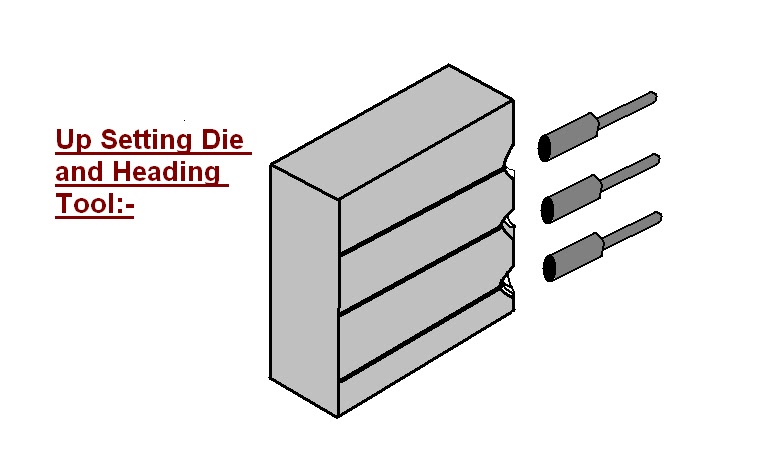
called up setter are generally horizontal acting. The die set consists of die
and corresponding punch or a heading tool. The die consists of two parts, one
called the stationary gripper die which is fixed to the machine frame and the
other movable gripper die which moves along with the die slide of the up
setter. The stock is held then between these two gripper dies.
The upset forging cycle start with the, movable die sliding against the
stationary die to grip the stock. The two dies when in closed position from
the necessary die cavity then the heading tool advance against the stock and
upset it to completely filled to the die cavity.
Having completed the upsetting the heading tool moves back to its back
position. Then the movable gripper die releases the stock by sliding backward.
Similar to drop forging it is not possible to get the final shape in a single
pass in machine forging also. Therefore the operation is carried out in number
of stages. The die cavities is required for the various operations are all
arrange vertically on the gripper dies. The stock is the move from stage one
to another in proper sequence till the final forging is ready. A heading tool
each for every upsetting stage is arranged on the heading slide of the
upsetting machine. A typical upsetting die and heading tool is shown:
Forging defects:
Though forging process give generally prior quality product compared other
manufacturing processes. There are some defects that are lightly to come a
proper care is not taken in forging process design.
A brief description of such defects and their remedial method is given below.
(A): Unfilled Section:
In this some section of the die cavity are not completely filled by the
flowing metal. The causes of this defects are improper design of the forging
die or using forging techniques.
(B): Cold Shut:
This appears as a small cracks at the corners of the forging. This is caused
manely by the improper design of die. Where in the corner and the fillet radie
are small as a result of which metal does not flow properly into the corner
and the ends up as a cold shut.
(C): Scale Pits:
This is seen as irregular depurations on the surface of the forging. This is
primarily caused because of improper cleaning of the stock used for forging.
The oxide and scale gets embedded into the finish forging surface. When the
forging is cleaned by pickling, these are seen as depurations on the forging
surface.
(D): Die Shift:
This is caused by the miss alignment of the die halve, making the two halve of
the forging to be improper shape.
(E): Flakes:
These are basically internal ruptures caused by the improper cooling of the
large forging. Rapid cooling causes the exterior to cool quickly causing
internal fractures. This can be remedied by following proper cooling
practices.
(F): Improper Grain Flow:
This is caused by the improper design of the die, which makes the flow of the
metal not flowing the final interred direction.
Forging operations:
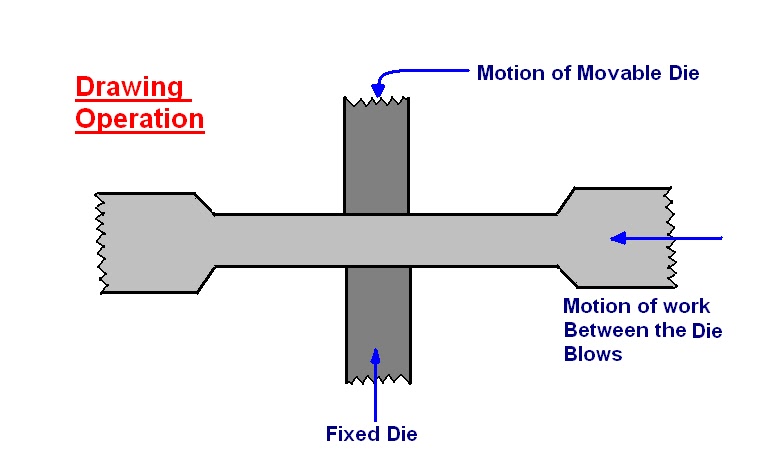
1: Drawing:
This is the operation in which metal gets elongated with a reduction in the
cross sedation area. For this, a force is to be applied in a direction
perpendiaulant to the length axis.
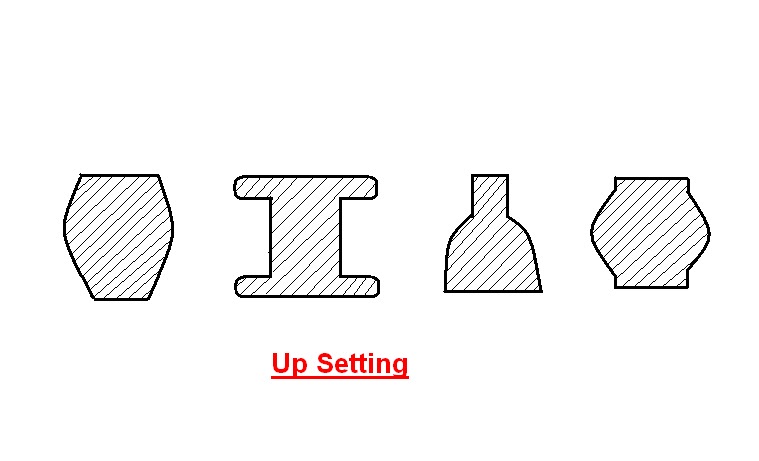
2:Up setting:
This is applied to increase the cross seat ional area of the stock at the
expanse of the length. To achieve the length of upsetting force is applied in
a direction parallel to the length axis, For example forming of a bolt head.
3:Fullering:
It a similar to material cross-section is decreased and length increased. To
do this; the bottom fuller is kept in angle hole with the heated stock over
the fuller .the top fuller is then kept above the stock and then with the
sledge hammer, and the force is applied on the top fuller.
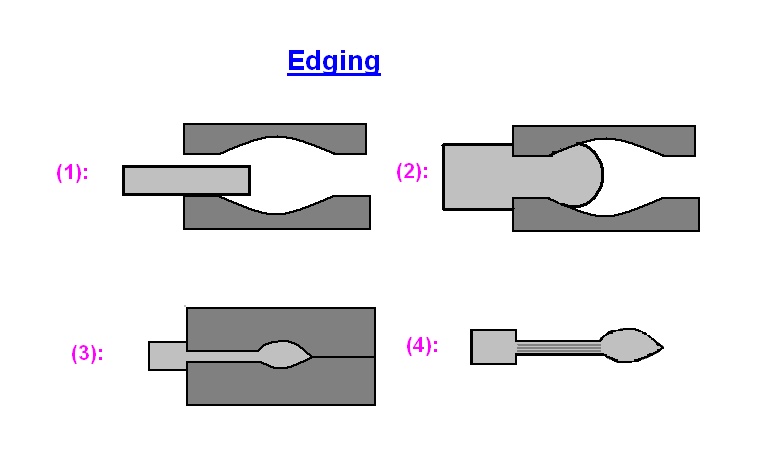
4:Edging:
It is a process in which the metal piece is displaced to the desired shape by
striking between two dies edging is frequently as primary drop forging
operation.
5:Bending:
Bending
is very common forging operation. It is an operation to give a turn to metal
rod or plate. This is required for those which have bends shapes.
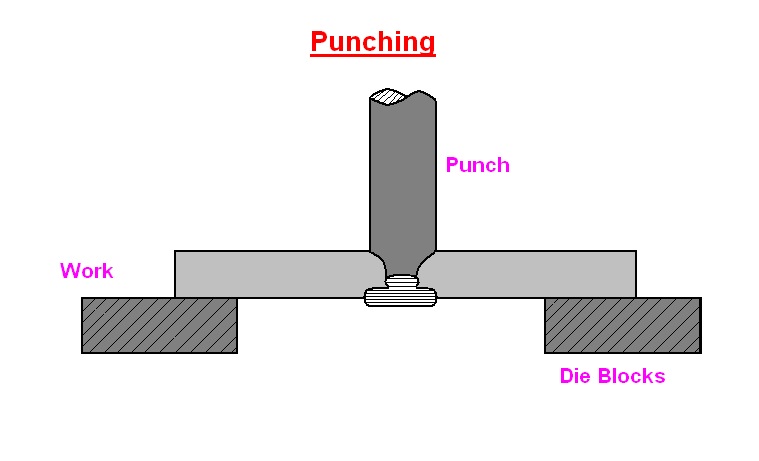
6:Punching:
It is a process of producing holes in motel plate is placed over the hollow
cylindrical die. By pressing the punch over the plate the hole is made.
7:Forged welding:
It is a process of joining two metal pieces to increase the length. By the
pressing or hammering then when they are at for ging temperature.Itis
performed in forging shop and hence is called forged welding.
8:Cutting:
It
is a process in which a metal rod or plate cut out into two pieces, with the
help of chisel and hammer, when the metal is in red hot condition.
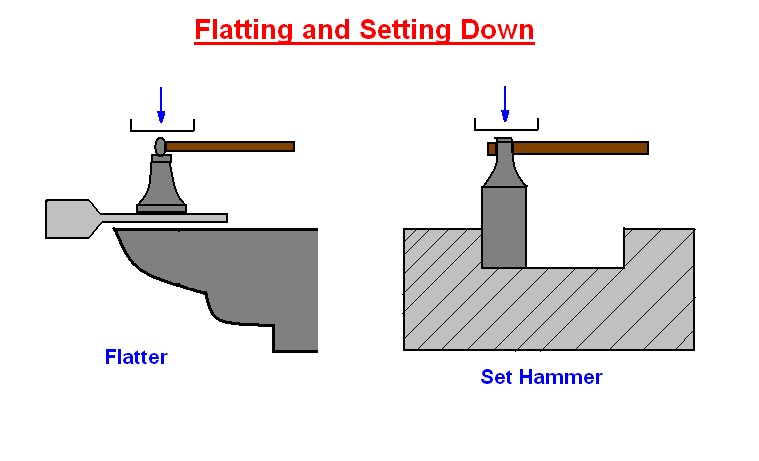
9:Flating and setting down:
Fullering leaves a corrugated surface on the job. Even after a job is forged
into shape with a hammer, the marks of the hammer remains on the upper surface
of the job. To remove hammer marks and corrugation and in order to obtain a
smooth surface on the job, a flatter or set hammer is used.
10: Swaging:
Swaging is done to reduce and finish work for desire size and shape, usually
either round or hexagonal. For small jobs top and bottom swage pair is
employed, where as for large work swage block can be used.