Planes & Planers
http://www.youtube.com/watch?v=rIkjoCxVTzM
Types of Plane
|
EXAMPLES OF PLANES |
| |
|
|

|
WOOD BLOCK PLANE:
Although this is a very old design they are still used today to remove a
large amount of wood. This is due to the fact that they are lighter than
steel planes and therefore they can be used comfortably for longer periods. |
| |
|
|

|
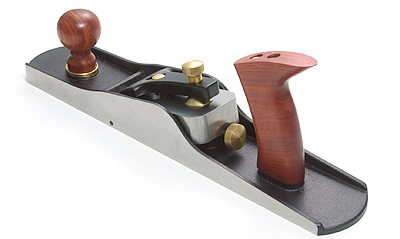
JACK PLANE: This is
the steel equivalent of the wooden block plane. It has a steel body and
because it is heavier than the wood block plane it is easier to hold down on
the surface of the wood being planed. It is used to plane longer pieces of
wood. |
| |
|
|

|
SMALL BLOCK PLANE:
This is a small version of a wood block plane and it is used for light work
such as producing 'chamfers'. It is normally held and used in one hand. |
| |
|
|
|

|
SMOOTHING PLANE: A
shorter version of the steel jack plane. It is used for general work such as
smoothing short pieces of wood. It is lighter and smaller than the jack
plane |
|
| |
|
|
|

|
BULLNOSE PLANE: This
is used to plain right into corners. The blade can be seen to go almost up
to the end of the plane's body and consequently very little material is
missed in a corner. |
|
| |
|
|
|
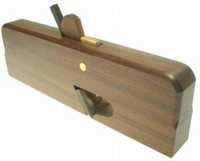
REBATE PLANE: Used
for producing shoulders or rebates. A good example is a base to a jewellery
box which is rebated into the sides. (See
Lapped Joint) |
| |
|
|

|
COMBINATION PLANE:
Used in a similar way to a rebate plane. It can be used for creating a
shoulder/rebate on the edge of a piece of wood. This plane has an advantage
over the rebate plane as it is adjustable for different widths. (See
Lapped Joint) |
|
|
|
| |
|
|

|
MACHINE PLANE: This
is favoured by DIY enthusiasts as it saves time. A blade revolves at high
speed and as the machine plane is pushed across the surface of the wood - it
is planed. A big disadvantage of these planes is that they are potentially
very dangerous if misused. Also, sometimes the finish to the surface is not
as smooth or precise as a hand held plane being carefully used. |
How to use a Smoothing Plane and Jack Plane
1. The wood must be placed level and firmly in
the vice.
2. Always plane in the direction of the
grain. Examine the wood carefully, it may be obvious which way the grain is
flowing.
3. If the plane sticks whilst in use, turn
the wood the opposite way round in the vice. Now the grain may be pointing in
the right direction.
4. Rub a little candle wax on the bottom of
the plane. This will help the plane glide across the surface of the wood.
5.
Make sure that little of the blade is sticking out off the bottom of the plane.
Too much of the blade will make using the plane very difficult and it may damage
the surface of the wood.
6. Always place the plane at the end of the
piece of wood and push it firmly across the entire length, without it lifting
off the surface. Lift the plane back to the starting position. Pulling the plane
back along the wood surface will 'blunt' the blade quickly.
7. Always use a sharp blade.
 |
 |
 |
 |
|
Jack plane |
Hand held power planer |
Planer thicknesser |
Curved-sole plane |
A thickness planer (also known in the UK and Australia as a thicknesser or in
North America as a planer) is a woodworking machine which is used to create
boards that are of an even thickness throughout their length and flat on both
surfaces.
Can I use a hand-held power planer for flattening or jointing plates?
No. Hand-held power planers are designed for rough carpentry work and cannot
be adjusted to the fine tolerances necessary for instrument making.
One small low-angle block plane
I recommend either of the Stanley or Record planes Nos. 9-1/2 or 60-1/2,
these have an adjustable throat which is useful for figured woods and for
end-grain, but are very expensive. Fixed throat planes of a similar sort such as
Stanley No. 220 are fine but do make sure that you can easily adjust the
side-to-side angle of the blade. The blades that come with these planes are
perfectly OK but better, laminated Japanese blades to fit these planes, can be
bought from some of the specialist suppliers. Japanese-style wooden pull planes
are an acquired taste, people tell me they are wonderful but I prefer the ease
of adjustment of the western iron body planes. Both Axminster and Dick now sell
Chinese or Taiwanese copies of these planes at about half the price. They appear
to be identical and even have identical stock numbers. I have not tried them but
they are probably functionally identical too.

When the width or thickness of a piece of wood needs reducing
by a small amount, a plane is normally used. However, if a large amount of wood
needs removing or the piece is very long, using a smoothing plane or jack plane
is time consuming and can be inaccurate. The best option is to use a machine
plane. These are relatively cheap and save time and effort.

The machine plane seen below has cutters that revolve at 1800
rpm (revolutions per minute). This makes it suitable for most woods. It has four
cutters mounted on a rotating drum (see diagram B). Always hold the plane with
two hands. NEVER use the plane with one hand as it is very easy to push it over
the fingers of the second hand. This would result in a very serious injury.
NEVER steady the wood to be planed in one hand whilst controlling the plane with
the other. A serious accident is inevitable. Only use a machine plane with a
dust collection bag fitted.

The rotating drum (shown in slow motion) and its four cutters
are seen in the sectional view shown below. The drum and cutters rotate in an
anticlockwise direction. The plane is pushed in the direction of the arrows -
this is the safest way to operate the plane. The height of the front base plate
can be adjusted so that more or less material can be planed from the wood.
