Reamer
A reamer is a tool to make conical bores.
This should be 1 in 30 taper, in other words the standard violin peg taper.
The specialist suppliers stock these. This will fit the pegs that Phil Brown
produces. For the renaissance lute, I strongly recommend the small spiral violin
reamer that Dick GmBH sells. It is the golden coloured reamer in the centre of
the picture and cuts like a dream. The gold colour is a ceramic coating which is
supposed to prolong its life. I used to use the quick spiral taper pin reamer at
1 in 50 taper. This, however, means that you have to use the harder wood for
pegs such as cocobolo, as a softer wood like plum will push through too much.
The advantage of these reamers is that they can be used in a hand drill or even
an electric drill and make fitting the pegs much quicker. But the new spiral
hand reamer is almost as quick and more controllable.

The picture shows the quick spiral taper pin reamer on the left, the hand
spiral small violin reamer in the centre and the violin reamer on the right
Reamer:
A reamer is a rotating cutting tool generally of cylindrical shape which is
used to enlarge and finish holes to accurate dimensions to previously formed
hole. It is a multiple edge cutting tool having the cutting edge on its
periphery.
Parts of Reamer:
A reamer consists of three mean parts:
<!--[if !supportLists]-->1. <!--[endif]-->Fluted
section
<!--[if !supportLists]-->2. <!--[endif]-->Neck
<!--[if !supportLists]-->3. <!--[endif]-->Shank
The fluted part consists of chamfer, starting taper, sizing section and back
taper length. Chamfer length or bevel lead insures proper and easy entry of
the reamer into the hole. The main cutting action of reamer is done by
starting taper, the sizing section and to guide the reamers and also smooth or
size the hole. The back taper reduces friction between reamers and the whole
surface.
Types of Reamers:
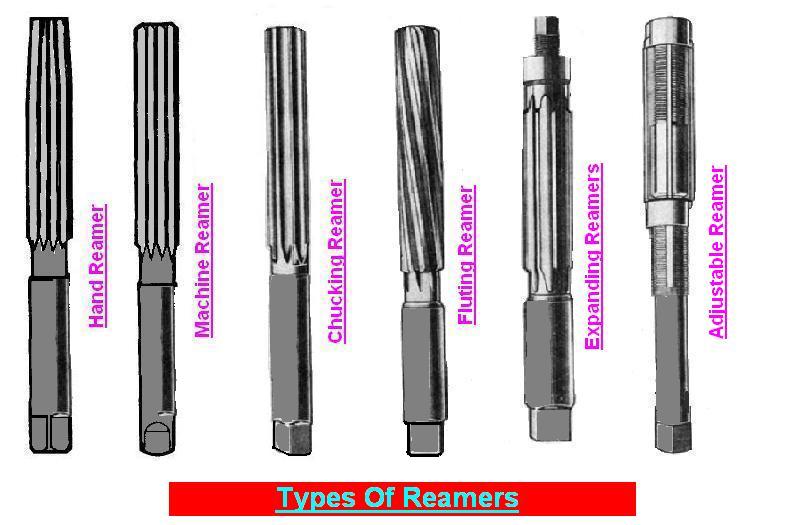
There are following types of reamers:
<!--[if !supportLists]-->· <!--[endif]-->Hand
Reamer
<!--[if !supportLists]-->· <!--[endif]-->Machine
Reamer
<!--[if !supportLists]-->· <!--[endif]-->Chucking
Reamer
<!--[if !supportLists]-->· <!--[endif]-->Fluting
Reamer
<!--[if !supportLists]-->· <!--[endif]-->Expanding
Reamer
<!--[if !supportLists]-->· <!--[endif]-->Adjustable
Reamer
<!--[if !supportLists]-->· <!--[endif]-->Shell
Reamer
1: Hand Reamer:
These reamers are operated by hand with a tap wrench fitted on the sequence of
the reamer. The work is hold in a vice. The flutes may be straight or helical.
Shank is straight with a square tang for the wrench.
2: Machine Reamer;
These are similar to hand reamer, except that the shank is tapered.
3: Chucking Reamers:
These are machine reamers with shorter flutes. These may be either of the type
known as rose reamers or fluted reamers. These are using for heavy roughing
cuts.
4: Fluting Reamers:
There the holder are not rigid but are fluting this permits the reamer. To
flow the previously made hole naturally and without restrained resulting in a
better hole.
5: Expanding Reamers:
These reamers allow slight increase in their size to allow for wear to remove
an extra amount of material. For this the body of the reamers is bored tapered
and is slitted. A taper plug runs through the hole end is operated by a screw
so that it acts as the expander.
6: Adjustable Reamers:
In these reamers separate blades are inserted in the grooves provided in the
body of the reamer. The blades can be moved up or down of the reamer.
7: Tapered Reamers:
These reamers are used to finish the taper holes for cutting the taper things
used to secure the collars, pulleys etc to the shaft.
8: Shell Reamers:
Solid reamers (upto about 20mm diameter or usually made of Hss) to reduce the
cost of larger reamers the cutting portion is made as separate shell which are
mounted on standard shanks made of lower cost steel. These reamers are however
do not very rigid and accurate inserted tooth or plates in shells in further
reduced the cost of reamers can tip with cemented carbides.