Back Saws
A backsaw is any hand saw which has a stiffening rib on the edge opposite the
cutting edge, allowing for better control and more precise cutting than with
other types of saws. Backsaws are normally used in woodworking for precise work,
such as cutting dovetails, mitres, or tenons in cabinetry and joinery. Because
of the stiffening rib, the backsaws are limited in the depth to which they can
cut. Backsaws usually have relatively closely spaced teeth, often with little or
no set.
 |
 |
 |
|
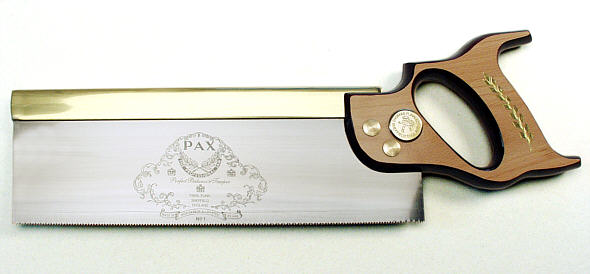
Tenon saw |
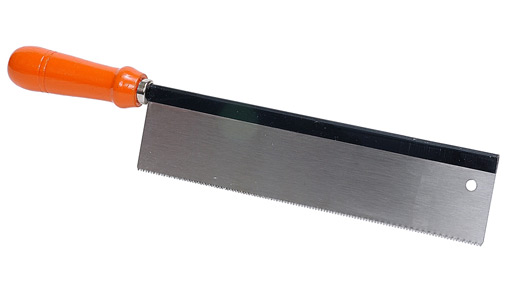
Dovetail saw |
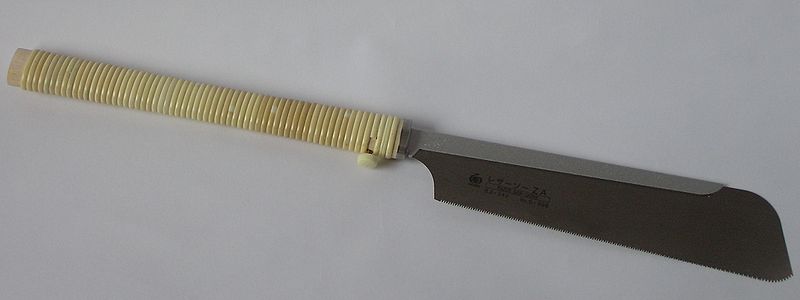
Dōzuki |
Types
Different types of backsaw include:
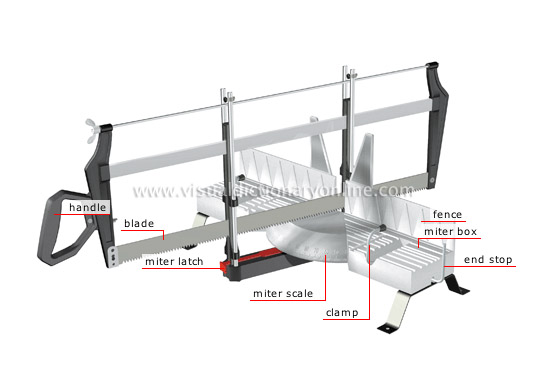
- Mitre saw — often referred to as a large backsaw (20-30 inches or 60–90
cm) used either in a wooden or metal mitre box or in a metal frame which
allowed cutting mitres of any specified angle. Note that not all mitre saws
are backsaws, and the electric mitre saw (or chop saw) has taken its place
today.
- Tenon saw — a midsized backsaw. The saw derives its name from its use in
the cutting of tenons for mortise and tenon joinery. Tenon saws are commonly
available with rip-filed teeth for rip cutting and cross-cut for cutting
across the grain. Teeth are relatively fine, with 13 teeth per inch being a
common size for the saw.
- Sash saw — name that seems to have been used in the 18th and 19th century
for a smaller tenon saw, used in fabricating window sashes. The term is also
used currently to refer to a thin, flexible saw used to free sashes that have
been painted shut.
- Dovetail saw — a small backsaw used to cut dovetails. Although most
dovetail saw teeth are set for cross-cutting, a rip saw tooth pattern is more
efficient. These saws will usually have a higher number of teeth per inch
(around 15 - 20 T.P.I.) with teeth sharpened to favor ripping operations and
set to leave a narrow kerf.
- Gent's saw — a small dovetail saw with a straight turned handle, rather
than an open one typical of most saws. The name seems to have arisen from its
use by the nineteenth century dilettante who would now be called a hobbyist.
It is adapted for use in making joints in very small woodwork such as that in
some musical instruments, dolls' furniture or other model-making. Its
distinguishing features are its small size and turned handle.
- Razor saw — a very small backsaw having very finely pitched crosscut
teeth, often with no set. The Razor saw is used by hobbyists, notably Model
aircraft, Model boat, and Model railroad enthusiasts. Razor saws typically use
disposable blades (or are occasionally designed to be completely disposable),
since their teeth are so small as to be impractical to re-sharpen. A razor saw
is capable of making clean cuts in very soft woods like Balsa, which most
other saws would tend to tear out. Unlike most other types of backsaws, razor
saws are also frequently used to cut plastics and soft metals.
- Dōzuki — a Japanese backsaw, used for centuries by carpenters and
cabinetmakers in Japan. Although this saw does not share an ancestry with the
other backsaws in this group, the concept is the same. Like most Japanese
saws, the dōzuki cuts on the pull stroke, allowing for much straighter and
narrower cuts than those achieved with push-stroke saws. This is due to
tension on the blade during the cut (versus compression for a western saw), so
less thickness is required to keep the saw blade straight.
Use
- The saw has to be held in the hand with the index finger pointing in the
direction of sawing. It also helps to support the whole saw as it moves
forward.
- When sawing a piece of wood, it is usually placed on a bench hook.
- The saw must not move from side to side or it will jam in the wood making
sawing difficult.
- The first few cuts with the saw must be made slowly. Once an initial
groove has been cut sawing should be easier.
- Slow down the cutting motion when the wood is almost sawn through. This
will prevent the wood splitting as the saw finally cuts the wood into two
pieces.
 |
|
Hand miter saw |
Safety
- Concentration is very important.
- The saw must always be held straight.