

Keyhole and compass saws are made to cut curved and straight sided holes in wood and other materials. Keyhole saws are smaller and narrower with 10 to 12 tpi while compass saws are a bit larger and range from 8 to 10 tpi.
They have either a fixed or removable blade which comes to a sharp point. Since they have a narrow, unsupported blade, keyhole and compass saws have a tendency to bend when cutting.
Japanese keyhole saws are available that cut on the pull stroke which reduces bending of the blade.
A powered compass saw is usually know as Jigsaw
|
|
|
| Compass saw | Jigsaw |
Jigsaws are general cutting and shaping tools. They are
provided with a selection of blades suitable for cutting and shaping a range of
materials. They are ideal for cutting thin manmade boards such as plywood and
MDF and they are capable of cutting detailed curves. They can also be used to
cut kitchen tops and quite thick material. Thin material (4mm to 6mm) can be cut
quite quickly but great care must be taken when cutting thicker material (6mm
upwards).
Safety and use of jigsaws are outlined below. Remember, before operating any
power tools you must receive training from a suitably qualified instructor.

1. Always plug power
tools into a RCB (circuit breaker) as a safety measure against electrical
faults.
2. Wear goggles to protect eyes from
dust/chippings and a face/dust mask to prevent breathing in dangerous dust
particles.
3. Always read the manufacturers
instructions very carefully and follow them.
4. Always seek instruction / training from
an appropriately qualified instructor before using any tools, especially power
tools.
5. Make sure that the mains cable cannot be
tripped over or that it causes a hazard in anyway.
6. G Cramp the material to be cut/shaped to
a firm workbench before starting.
7. Fit an extraction bag to the jigsaw. This
will collect most of the dust.
8. Use the guard at all times.
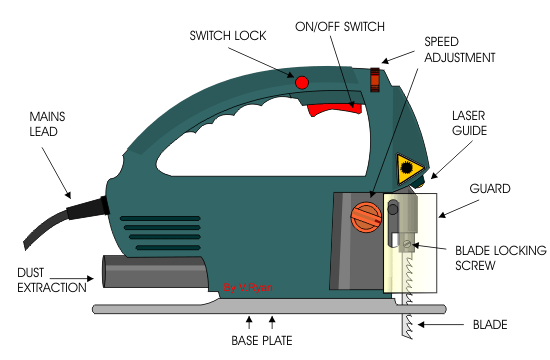
Below is a typical jigsaw. The ON/OFF switch is located on
the handle as well as the switch lock. When the switch is pressed the jigsaw
starts although holding the switch in position whilst cutting can be
uncomfortable. However, if the switch lock is also pressed this holds the switch
in position which means that finger pressure on the switch can be released and
the jigsaw continues to work.
Two speed adjustments are seen on this model of jigsaw. They alter the speed at
which the blade moves up and down. The speed of the blade is determined by the
type of material being cut. Usually a jigsaw will be proved with a table of
speeds relating to materials.

A selection of blades can be fitted to a jigsaw. The type of
blade depends on the material. Furthermore, coarse blades with ‘rugged’ teeth
are normally used to make rough cuts whilst blades with fine, numerous teeth are
used to cut and shape very accurately.
For example, cutting an accurate and smooth curve in MDF will mean that a fine
blade with at least 21 teeth per inch (TPI) will be fitted.
To fit the blade the guard is moved back and usually a screwdriver is used to
loosen the blade locking screw. The blade can then be removed and replaced. More
modern jigsaws have quick release mechanisms that allow very quick replacement
of blades.

A laser guide is quite common on jigsaws and other power tools. The laser is a precise beam of light that shines accurately in front of the jigsaw. This can be used as a guide which shows exactly where the jigsaw blade is to cut. Remember, lasers are dangerous and the light should never be shined directly into eyes.
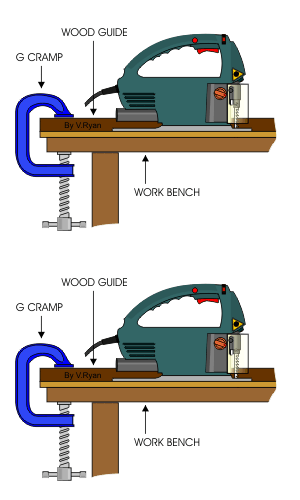
If the wood to be cut and a wood guide is G Cramped to a work bench it will be possible to cut in a straight and accurate line. The jigsaw is pressed against the guide whilst been pushed in the direction of the cut. Wood guides are very useful and they are safe if used properly.

When cutting an internal shape a hole must first be drilled so that the jigsaw blade can fit inside the shape. The jigsaw can then follow the line round the shape. For this type of work a fine blade is used so that the finished cut is smooth and accurate.
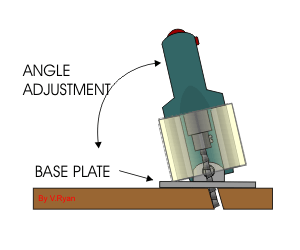
The base plate of the jigsaw can be adjusted so that an angle of up to 45 degrees can be achieved. The jigsaw becomes more difficult to handle when set at an angle. Also, the angle may need to be finished with a smoothing plane to remove the rough surface.