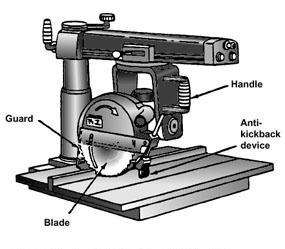

A radial arm saw is a cutting machine consisting of a circular saw mounted on a sliding horizontal arm. Invented by Raymond De Walt in 1922, the radial arm saw was the primary tool used for cutting long pieces of stock to length until the introduction of the power miter saw in the 1970s.
In addition to making length cuts, a radial arm saw may be configured with a dado blade to create cuts for dado, rabbet or half lap joints. In addition some radial arm saws allow the blade to be turned parallel to the back fence, allowing a rip cut to be performed.
A power miter saw, also known as a chop saw or drop saw, is a power tool used to make a quick, accurate crosscut in a workpiece at a selected angle.
A primary distinguishing feature of the miter saw is the miter index that allows the angle of the blade to be changed relative to the fence. While most miter saws enable precise one-degree incremental changes to the miter index, many also provide "stops" that allow the miter index to be quickly set to common angles (such as 15°, 22.5°, 30°, and 45°).
|
|
|
| Radial arm saw | Power miter saw |
Radial arm saws require a blade with a very low or negative hook angle, to inhibit overly fast feed rate, binding, and the blade's tendency to try to climb the material.
Also a 10 deg. positive hook blade with a "triple chip profile" works well on the radial arm saw and can be considered a universal blade. If the saw climbs with this blade, the yoke roller bearings need to be adjusted and tightened.