When a force is applied on a surface in a direction perpendicular to the surface, the force is called thrust.
Pressure is the ratio of force applied in a direction perpendicular to the surface of an object, to the area over which that force is distributed. Pressure is a scalar quantity, not a vector quantity. The SI unit of pressure is the newton per square metre, which is called the pascal (Pa). A pressure of 1 Pa is small; it approximately equals the pressure exerted by a dollar bill resting flat on a table.
Pressure on a solid surface is the thrust per unit area of the surface.
Fluid pressure occurs in one of three situations:
Blaise Pascal, a French physicist, discovered that the pressure in a fluid in equilibrium is the same everywhere, if the effect of gravity is neglected.
 When
the effect of gravity cannot be neglected, but the liquid is at rest, the net
force acting on it should be zero.
When
the effect of gravity cannot be neglected, but the liquid is at rest, the net
force acting on it should be zero.


If A and B were at the same height, i.e. h=0 then P2 - P1=0 or P1 = P2 i.e., Pressure is same at all points inside a liquid lying on the same horizontal plane.
If g = 0 at place, then P2 = P1 at any two points inside the liquid (Pascal's law neglecting effect of gravity).
Pressure in open conditions usually can be approximated as the pressure in "static" or non-moving conditions (even in the ocean where there are waves and currents), because the motions create only negligible changes in the pressure. Such conditions conform with principles of fluid statics. The pressure at any given point of a non-moving (static) fluid is called the hydrostatic pressure.
Closed bodies of fluid are either "static", when the fluid is not moving, or "dynamic", when the fluid can move as in either a pipe or by compressing an air gap in a closed container. The equation makes some assumptions about the fluid, such as the fluid being ideal (no friction, it is inviscid, zero viscosity) and incompressible. The equation is written between any two points a and b in a system that contain the same fluid.

where:
 = pressure head
 = velocity head
In an ideal gas, molecules have no volume and do not interact. Pressure varies linearly with temperature, volume, and quantity according to the ideal gas law,

where:
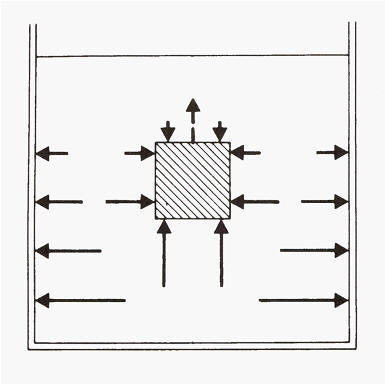
When a person swims under the water, water pressure is felt acting on the person's eardrums. The deeper that person swims, the greater the pressure. The pressure felt is due to the weight of the water above the person. As someone swims deeper, there is more water above you and therefore greater pressure. The pressure a liquid exerts depends on its depth.
Liquid pressure also depends on the density of the liquid. If someone was submerged in a liquid more dense than water, the pressure would be correspondingly greater. The pressure due to a liquid in liquid columns of constant density or at a depth within a substance is represented by the following formula:

where:

S.I unit of pressure is  or
Pascal (Pa) and its dimensional formula is [ML-1T-2
]
or
Pascal (Pa) and its dimensional formula is [ML-1T-2
]

Consider a liquid of density 'r' contained in a cylinder of cross-sectional area 'A'. Let 'h' be the height of the liquid column. The weight of liquid will exert a downward thrust on the bottom surface of the vessel. The weight of liquid inside the vessel = volume x density x g = Ahrg
Thrust or force of liquid on the area = weight of liquid = Ahrg

Pressure exerted by a liquid column = hrg
The above expression tells us why dams are broader at the bottom. The liquid pressure increases with breadth.
With a broader base, the pressure on the walls of the dam are reduced.
The pressure exerted by a liquid on the base of the container depends on the vertical height of the liquid over it not on the area of cross-section. As one goes deeper in the swimming pool, the pressure on the ear drum is found to increase.
The pressure exerted by a liquid on the base of the container depends on the vertical height of the liquid over it not on the area of cross-section. As one goes deeper in the swimming pool, the pressure on the ear drum is found to increase.
The transmission of power is made use of in hydraulic machines where a small force applied at one point is made to exert a much larger force at some other point. This principle is made use of in the working of a hydraulic press and hydraulic brakes.
The atmosphere is the layer of air around the earth. It extends up to 1000 km above the surface of the earth and has a total weight of 4.5 1018 kg (i.e., five million billion tons).
A barometer is a device for measuring the atmospheric pressure.
It is a simple pressure gauge and it measures differences in pressure exerted at the two ends of the apparatus. It is called manometer. The mouth of a thistle funnel is tightly covered with a thin plastic sheet.
A cork is pushed down into water kept in a glass. We find that as soon as it is released, the cork rises on its own and comes to the surface.
Any liquid or gas produces upthrust. For example, the upthrust of air keeps a hot air balloon up.
The underlying fact on which the principle is based was discovered by Archimedes in about 300 B.C. The story goes that the King of Sicily suspected that the goldsmith has mixed some silver in his crown and cheated him. Without destroying the crown he wanted to know the truth. Archimedes was asked to find out whether this was so, without destroying the crown.
Relative density (RD) of a substance is defined as the ratio of the density of the substance to density of water at 4oC.
A solid weighs 50 gf in air and 44 gf when completely immersed in water. Calculate (i) R.D of the solid (ii) upthrust (iii) density of the solid in cgs and SI units.
Usually, all bodies less than that of water float, bodies which are denser than water sink. You might have noticed that a piece of steel sinks, but a ship made of steel floats. This is because of the design of the ship. The steel body of the ship encloses large quantity of air. Thus, the average density of the ship is less than that of water and the ship floats in water.
The submarine is another application of 'Archimedes Principle'. On surface, the submarine floats, with its conning tower and most of the deck, being clear of the water.
Hydrometer is an instrument used for determining the density of a liquid. It usually consists of a glass float with a long thin stem which is graduated. The glass float is a large hollow bulb which increases the buoyancy so that the hydrometer floats. The narrow stem increases the sensitivity of the hydrometer. The bottom of the hydrometer is made heavier by loading it with lead shots so that it floats vertically.
Pressure at a point in a liquid depends upon the depth and on the density of the liquid