Orders of magnitude are generally used to make very approximate comparisons. Two numbers of the same order of magnitude have roughly the same scale: the larger value is less than ten times the smaller value. If two numbers differ by one order of magnitude, one is about ten times larger than the other. If they differ by two orders of magnitude, they differ by a factor of about 100.
The order of magnitude of a number is, intuitively speaking, the number of powers of 10 contained in the number. More precisely, the order of magnitude of a number can be defined in terms of the common logarithm, usually as the integer part of the logarithm, obtained by truncation. For example, the number 4,000,000 has a logarithm (in base 10) of 6.602; its order of magnitude is 6.
This is the reasoning behind significant figures: the amount rounded by is
usually a few orders of magnitude less than the total, and therefore
insignificant.
An order-of-magnitude difference between two values is a factor of 10. For example, the mass of the planet Saturn is 95 times than of Earth, so Saturn is two orders of magnitude more massive than Earth. Order-of-magnitude differences are called decades when measured on a logarithmic scale.
| In words (long scale) |
In words (short scale) |
Prefix | Symbol | Decimal | Power of ten |
Order of magnitude |
||||
|---|---|---|---|---|---|---|---|---|---|---|
| quadrillion | septillion | yotta- | Y | 1,000,000,000,000,000,000,000,000 | 1024 | 24 | ||||
| trilliard | sextillion | zetta- | Z | 1,000,000,000,000,000,000,000 | 1021 | 21 | ||||
| trillion | quintillion | exa- | E | 1,000,000,000,000,000,000 | 1018 | 18 | ||||
| billiard | quadrillion | peta- | P | 1,000,000,000,000,000 | 1015 | 15 | ||||
| billion | trillion | tera- | T | 1,000,000,000,000 | 1012 | 12 | ||||
| milliard | billion | giga- | G | 1,000,000,000 | 109 | 9 | ||||
| million | million | mega- | M | 1,000,000 | 106 | 6 | ||||
| thousand | thousand | kilo- | k | 1,000 | 103 | 3 | ||||
| hundred | hundred | hecto- | h | 100 | 102 | 2 | ||||
| ten | ten | deca- | da | 10 | 101 | 1 | ||||
| one | one | – | – | 1 | 100 | 0 | ||||
| tenth | tenth | deci- | d | 0.1 | 10−1 | −1 | ||||
| hundredth | hundredth | centi- | c | 0.01 | 10−2 | −2 | ||||
| thousandth | thousandth | milli- | m | 0.001 | 10−3 | −3 | ||||
| millionth | millionth | micro- | µ | 0.000.001 | 10−6 | −6 | ||||
| milliardth | billionth | nano- | n | 0.000.000.001 | 10−9 | −9 | ||||
| billionth | trillionth | pico- | p | 0.000.000.000.001 | 10−12 | −12 | ||||
| billiardth | quadrillionth | femto- | f | 0.000.000.000.000.001 | 10−15 | −15 | ||||
| trillionth | quintillionth | atto- | a | 0.000.000.000.000.000.001 | 10−18 | −18 | ||||
| trilliardth | sextillionth | zepto- | z | 0.000.000.000.000.000.000.001 | 10−21 | −21 | ||||
| quadrillionth | septillionth | yocto- | y | 0.000.000.000.000.000.000.000.001 | 10−24 | −24 |
Other orders of magnitude may be calculated using bases other than 10. The ancient Greeks ranked the nighttime brightness of celestial bodies by 6 levels in which each level was the fifth root of one hundred (about 2.512) as bright as the nearest weaker level of brightness, so that the brightest level is 5 orders of magnitude brighter than the weakest, which can also be stated as a factor of 100 times brighter.
It is important to understand and be able to compare the size of things we are studying . The following table shows a summary.
To illustrate the limits of the matter and of the Universe, in 1957 Kees Boeke wrote the book Cosmic View. After this book, in 1968 Charles and Ray Eames wrote and directed the documentary short film Powers of Ten™
| Size/distance of the object | Order of magnitude (m) |
|---|---|
| Radius of nucleus | 10 -14 |
| Diameter of an atom | 10 -10 |
| Radius of hydrogen atom | 10 -11 |
| Mean free path of air molecule | 10 - 6 |
| Thickness of a sheet of paper | 10 - 4 |
| Height of a man | 10 |
| Height of Mount Everest | 104 |
| Radius of earth | 107 |
| Distance of earth from sun | 1011 |
| Distance of nearest star from earth | 1016 |
| Size of Milky way (Galaxy) | 1021 |
| Size of universe | 1025 |
Masses of objects also have values of wide range. They are tabulated as below in the order of magnitude.
| Object | Order of magnitude (kg) |
|---|---|
| Electron | 10 -31 |
| Proton | 10 - 27 |
| Uranium atom | 10 - 25 |
| Cell | 10 - 10 |
| Earth | 10 25 |
| Sun | 10 30 |
| Galaxy | 10 22 |
| Universe | 10 55 |
Time also has a wide range of values. They are tabulated below in the order of their magnitude.
| Event | Order of magnitude (s) |
|---|---|
| Time taken by light to cross distance of nuclear size [time proportion to revolve once in nucleus] | 10 - 22 |
| Time period of an electron in H2 atom | 10 - 15 |
| Time taken by light to pass through glass of a window pane | 10 - 11 |
| Time interval between heartbeats | 10 - 2 |
| One minute | 10 2 |
| One day | 10 5 |
| One year | 10 7 |
| Average life span of a human being | 10 9 |
| Age of earth | 10 17 |
| Life of Sun | 10 18 |
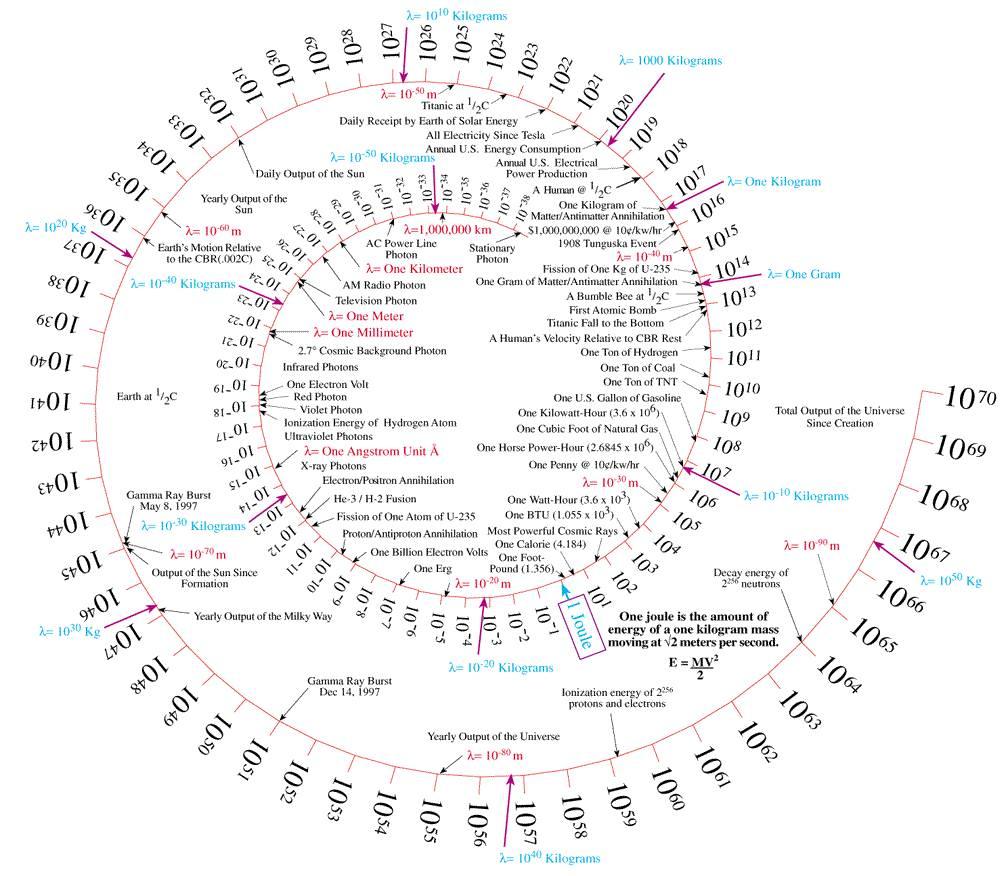
The following diagram illustrates and help to better understand the Energy scale of the Universe.