Browning, Bluing and Blackening
Pavonado
El pavonado es un acabado para piezas de acero, de gran duración, efecto
decorativo y resistencia a la corrosión. El ácido ferroso-ferrico que se forma
protege el hierro subyacente de su ulterior alteración.
El pavonado atrae y retiene los aceites lubricantes. El revestimiento no
aumenta ni disminuye las dimensiones de los metales tratados, por lo que las
tolerancias para el ajuste de piezas no se ven afectadas. Además, las
superficies tratadas pueden ser soldadas, enceradas, barnizadas o pintadas.
Los colores que se obtienen varían del negro al azulado, según la clase de
aleación tratada. A veces el tono es marrón. Los tonos negros y azules se dan
con pinturas de sales de diversos metales y el colorante correspondiente.
Se obtiene un revestimiento mate cuando se aplica sobre una superficie
tratada con chorro de arena o con un mordiente químico, y un revestimiento
brillante sobre una superficie pulida o lisa.
El pavonado se puede aplicar a herramientas de corte, resortes, castillos de
válvula, portaherramientas, fijadores, moldes, componentes y bloques de máquinas
hidráulicas, cadenas, ruedas dentadas, engranajes, tornillos, herramientas
manuales y de máquinas, componentes automotores en general, etc.
Procedimientos de pavonado
El pavonado se puede aplicar de forma sencilla, económica y segura, aunque
también hay procedimientos peligrosos. Los procesos de pavonado se pueden
dividir en dos grandes grupos: en caliente y en frío. La mayoría de las recetas
se refieren al pavonado en caliente, que corresponde con los métodos
tradicionales.
El pavonado en frío se realiza a temperatura ambiente (20 a 30ºC) y utiliza
soluciones líquidas concentradas (p. ej. de la marca Blackfast) que se disuelven
en agua y a través de reacciones químicas producen un acabado negro, adherente y
uniforme en la superficie de las piezas tratadas. Se trata de un proceso
ecológico, extremadamente sencillo y seguro. Se pueden tratar piezas de acero y
hierro fundido con tenor de cromo inferior al 12%. Estos procedimientos suelen
ser más ornamentales que protectores. Para aumentar la protección es necesario
aplicar al final una capa de aceite hidrófugo que sella los micro-poros.
El pavonado en caliente puede realizarse a baja (135-140ºC) o a alta
temperatura (250-1000ºC).
El pavonado en caliente a baja temperatura utiliza distintos productos
químicos (normalmente sales cáusticas) y a veces se lo conoce como pavonado
químico o pavonado con sales. Pueden conseguirse distintos tonos desde marrones
y azulados a negros. Algunas fórmulas desprenden gases o salpicaduras que son
muy venenosas o corrosivas y deben manejarse con extremado cuidado. Pueden no
funcionar en acero con contenido de cromo superior al 12%.
El pavonado en caliente a alta temperatura suele ser sencillo pues sólo
requiere de un horno o una llama y algún producto fácil de conseguir como cuero,
aceite, etc. Pero tiene el principal inconveniente de que la temperatura puede
afectar al temple de la pieza. También puede producir deformaciones, pues es
difícil conseguir una temperatura homogénea, por lo que suele usarse para piezas
pequeñas o en trabajos artesanales, donde puede dedicarse más tiempo a cada
pieza.
En todos los casos hay que tener en cuenta que una de las principales
características del pavonado es que la capa protectora es tan fina que no se
modifican las dimensiones de las piezas. Esa misma es la causa de que el
pavonado no oculta los defectos, por lo que para un acabado correcto los
trabajos de pulido, limpieza, desengrase y aclarado previos son incluso más
importantes que el pavonado en sí mismo.
En general, la pieza debe estar libre de grasa, y en muchos casos, también de
óxido. Esto puede requerir algún proceso previo al pavonado propiamente dicho.
Igualmente, según el tipo de acabado que se desee, mate o brillante, puede ser
necesario aumentar la rugosidad de la superficie o, contrariamente, un pulido
previo.
Clasificación
- Por medio de la acción del calor:
- mediante calentamiento de la pieza inmersa en un liquido, mezcla de
diversos productos químicos
- cubrición o enterramiento en elementos simples o compuestos de
graduación fina
- por la acción directa o indirecta del calor sobre la pieza a pavonar.
- Pavonado por oxidación lenta:
Se obtiene una pasta y se aplica "a muñequilla" en sucesivas etapas.
- Pavonado negro al ácido:
Las formulas de oxidación por este procedimiento contienen compuestos muy
peligros y venenosos.
Se aplican en general mediante brochas y en varias veces.
- Pavonado directo o indirecto por calor:
Usado generalmente para pequeñas piezas. El color que se obtiene en general
suele ser azulado brillante.
- Pavonado por cubrimiento:
Se basa en enterrar la pieza a pavonar y calentar.
Material necesario
Antes de comenzar hay que tenerlo todo preparado. Además de los elementos de
seguridad personal (guantes de goma, gafas de protección, mono de trabajo o ropa
vieja, etc., podemos necesitar las vasijas y recipientes de vidrio o acero
inoxidable, un suministro de agua corriente fría y caliente, alguna vasija de
plástico para el desengrase previo, un termómetro que pueda medir temperaturas
de 150º centígrados o más, alicates o pinzas para manipular las piezas calientes,
una balanza que permita pesar con una exactitud de un gramo, una probeta o vaso
graduado para medir líquidos, alambres para preparar un sistema de cuelgue de
las piezas para que no toquen el fondo y las paredes... y todo lo que permita
trabajar cómodo y seguro.
Si se van a usar productos químicos corrosivos o venenosos el lugar debe
estar bien ventilado y disponer de salida de emergencia. Hay que haber leído las
medidas de seguridad de cada producto.
Iron oxides and rust
Throughout history, manufacturers have explored different metal finishing
processes to protect their carefully crafted products from oxidisation. Their
solution to the problem was to oxidise the metal surface and render it inactive
from further attack.
Rust
Rusting is the common term for corrosion of iron and its alloys, such as
steel. In colloquial usage, the term is applied to red oxides, formed by the
reaction of iron and oxygen in the presence of water or air moisture. Other
forms of rust exist, like the result of reactions between iron and chloride in
an environment deprived of oxygen which generates green rust. Many other metals
undergo equivalent corrosion, but the resulting oxides are not commonly called
rust.
Strictly speaking, rust consists of hydrated iron(III) oxides Fe2O3·nH2O
and iron(III) oxide-hydroxide FeO(OH)·Fe(OH)3. Several forms of rust
are distinguishable visually and by spectroscopy, and form under different
circumstances.
When impure (cast) iron is in contact with water, oxygen, or other strong
oxidants, or acids, it rusts. Iron metal is relatively unaffected by pure water
or by dry oxygen. If salt is present, the iron tends to rust more quickly, as a
result of electrochemical reactions.
As with other metals, like aluminium, a tightly adhering oxide coating, a
passivation layer, protects the bulk iron from further oxidation, but the
combined action of two agents, usually oxygen and water converts the passivating
ferrous oxide layer to disintegrative rust.
In comparison with a tightly adhering oxide coating, rust, the hydrated red
oxide of iron (Fe2O3), undergoes an extremely large volume
change upon hydration; as a result, the oxide easily flakes off causing the
typical reddish rusting away of iron and provides no protection to the
underlying iron.. Given sufficient time, oxygen, and water, any iron mass will
eventually convert entirely to rust and disintegrate.
Iron oxides
Among the many known oxides, hydroxides and oxyhydroxides of iron , there are
three iron oxides (chemical compounds composed only of iron and oxygen):
-
Iron(II) oxide, also known by its former name
ferrous oxide or informally as iron monoxide. It is black-coloured with the
chemical formula FeO. It consists of the chemical element iron in the
oxidation state of II (Fe2+) bonded to oxygen. Its mineral form is known as
wüstite. FeO is thermodynamically unstable below 575 °C, disproportionating to
metal and Fe3O4 (4FeO --> Fe + Fe3O4).
-
Iron(III) oxide or ferric oxide is the inorganic
compound with the formula Fe2O3. Several phases or
structure have been identified. As the mineral known as hematite (alpha phase
or α-Fe2O3), iron(III) oxide is the most common form and
the main source of the iron for the steel industry. Fe2O3 is dark red, and readily attacked by acids. Iron(III) oxide is often
called rust, and to some extent this label is useful, because rust shares
several properties and has a similar composition but, to a chemist, rust is
only considered an hydrated ferric oxide.
-
Iron(II,III) oxide is the chemical compound with
formula Fe3O4. It occurs in nature as the mineral
magnetite. It contains both Fe2+ and Fe3+ ions and is sometimes formulated as
FeIIFeIII2O4 or as FeO ∙ Fe2O3.
It is black-coloured and exhibits permanent magnetism.
Deoxidizing and cleaning
El éxito de un pavonado depende de un perfecto desengrasado de las piezas.
Es muy importante que la pieza debe estar libre de grasa, y en muchos casos,
también de óxido. Esto puede requerir algún proceso previo al pavonado
propiamente dicho. Igualmente, según el tipo de acabado que se desee, mate o
brillante, puede ser necesario aumentar la rugosidad de la superficie o,
contrariamente, un pulido previo.
Soluciones desoxidantes
Soluciones desengrasantes
Rust protection
There are many processes to get a protective coating to steel and, among
them, those based in creating an oxide passivating shell are the oldest and
cheapest. Blued finish options are offered as the least expensive finish, and
this finish is also the least effective at providing rust resistance, relative
to other finishes such as Parkerizing or hard chrome plating or nitriding
processes like Tenifer.
When exposed to air, many metals naturally form a hard, relatively inert
surface. The reduction of the rate of corrosion will vary, depending on the
metal and its environment, and is notably slowed at room-temperature air for
aluminium, chromium, zinc, titanium, and silicon (a metalloid); the shell
inhibits deeper corrosion, and so is the key factor of passivation. The inert
surface layer, termed the ‘’native oxide layer‘’, is usually an oxide or a
nitride, with a thickness of a monolayer (1-3Å) for a noble metal like platinum,
about 15 Å for silicon and nearer to 50Å for aluminium after several years.
Rust protection on steel based in creating an oxide passivation coating
varies depending on which the oxide is:
- Browning: Iron(III) oxide
- Backening or Bluing: Iron(II,III) oxide. According to the process, they
are referred as 'cold', 'hot', 'rust blue' "fume blue' etc. But not always are
true oxidizing blackening. Some prefer to call thin coatings of black oxide by
the name bluing, and to call heavier coatings by the name black oxide (or
blackening), but they are both the same chemical conversion process.
Many older browning and bluing formulae are based on corrosive solutions
(necessary to cause metal to rust), and often contain cyanide solutions that are
especially toxic to humans.
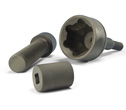
Comparison of Coatings for Iron and Steel
|
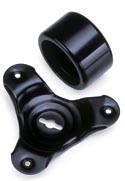
Black Oxide
|
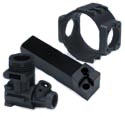
Cold Blackener
|
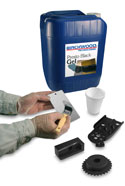
Cold Blackener (gel)
|
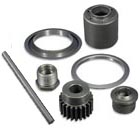
Aluminum Oxide
|
Zinc Phosphate
|
| |
 |
 |
 |
 |
 |
|
Colour:
|
Satin Black |
Satin Black |
Satin Black |
Satin Silver/Gray |
Matte Gray |
|
Coating:
|
Magnetite |
Copper Selenide |
Copper Selenide |
Aluminum Oxide |
Zinc Phosphate |
|
Temp:
|
93 °C |
20 °C |
20 °C |
65 °C |
65 °C |
|
Application:
|
Immersion |
Immersion |
Brush-On |
Immersion |
Immersion |
|
Time:
|
30 min |
20 min |
2-10 min |
20 min |
20 min |
Browning
Browning is controlled red rust Fe2O3 and is also known
as pluming or plum brown.
One can generally use the same solution to brown as to blue. The difference
is immersion in boiling water for bluing; the rust then turns to black-blue Fe3O4.
Blackening
Black oxide or blackening is an electrochemical process for ferrous materials
in which the surface is converted into an oxide coating resulting from an
oxidizing chemical reaction with iron on the surface selectively forming
magnetite (Fe3O4), the black oxide of iron. It is used to
add mild corrosion resistance, for cosmetic appearance, to minimise light
reflection and to helps to maintain the metal finish by resisting tangential
scratching.
Traditionally, blackening was called bluing and now the later designates only
the traditional procedures to distinguish them from some other more modern black
oxide coatings, although bluing is a subset of black oxide coatings.
Blackening and bluing are passivation processes (in which steel is partially
protected against rust), and is named after the blue-black appearance of the
resulting finish. One of its advantages over other coatings is its minimal
build-up.
Black oxide provides small protection against corrosion, unless also treated
with a water-displacing oil or wax to reduce wetting and galvanic action.
Bluing, being a chemical conversion coating, is not as robust against wear
and corrosion resistance as plated coatings, and is typically no thicker than
2.5 micrometers. For this reason, it is considered not to add any appreciable
thickness to precisely-machined parts.
Se obtiene un revestimiento mate cuando se aplica sobre una superficie
tratada con chorro de arena o con un mordiente químico, y un revestimiento
brillante sobre una superficie pulida o lisa.
El pavonado se puede aplicar a herramientas de corte, resortes, castillos de
válvula, portaherramientas, fijadores, moldes, componentes y bloques de máquinas
hidráulicas, cadenas, ruedas dentadas, engranajes, tornillos, herramientas
manuales y de máquinas, componentes automotores en general, etc.
El pavonado en caliente puede realizarse a baja (135-140ºC) o a alta
temperatura (250-1000ºC).
The caustic soda of the blackening compound bonds chemically to the surface
of the metal, creating a porous base layer on the part. Oil is then applied to
the heated part, which seals it by "sinking" into the applied porous layer. It
is the oil that prevents the corrosion of the workpiece. There are many
advantages of blackening, mainly:
- blackening can be done in large batches (ideal for small parts)
- no significant dimensional impact (the blacking process creates a layer
about a micrometre thick)
- it is far cheaper than similar corrosion protection systems, such as paint
and electroplating
Cold bluing
Cold bluing (or cold black oxide) is applied at
room temperature.
Modern cold bluing is not an oxide conversion coating, but rather a deposited
copper selenium dioxide based compound that colours steel black, or more often a
very dark grey.
There are compounds difficult to apply evenly which tends to rub off easily,
offers minimal protection and is generally best used for small fast repair jobs
and touch-ups to prevent a small scratch from becoming a major source of rust
over time.
There are also Copper Selenoid Phosphate solutions which provide corrosion
protection that surpasses that of the traditional hot black oxide method. The
corrosion protection is afforded due to the holding ability of the
microcrystalline converted surface. The bound microcrystalline black surface
adheres applied corrosion inhibitors to the surface for a longer period of time.
Hot bluing or Traditional Caustic Blackening
The 'hot' process may be applied, for example, by immersing the steel parts
to be blued in an alkali salt solution (solution of potassium nitrate and sodium
hydroxide in water, and even some nitrites) heated to the boiling point, 135°C
to 154°C, depending on the recipe. Water must be periodically added to the bath,
with proper controls to prevent a steam explosion.
Similarly, stainless steel parts to be blued are immersed in a mixture of
nitrates and chromates, heated to the boiling point.
Hot blackening involves dipping the part into various tanks. These tanks
contain, in order, alkaline cleaner, water, the hot blackening solution, and
finally the sealant, which is usually oil.
This method was adopted by larger firearm companies for large scale, more
economical bluing. It does provide good rust resistance which is improved with
the use of oil.
This process is not safely used to re-blue vintage shotguns. Many double
barrelled shotguns are silver brazed together and many of the parts are attached
by that method also. The higher temperatures of the 'hot' processes as well as
their caustic nature can weaken the brazed joints and make the gun hazardous to
use.
Large scale industrial hot bluing is often performed using a bluing furnace.
This is an alternative method for creating the black oxide coating. In place of
using a hot bath (although at a lower temperature) chemically-induced method, it
is possible through controlling the temperature to heat steel precisely such as
to cause the formation of black oxide selectively over the red oxide.
There are several other methods of hot bluing. The oldest and most widely
used specification for hot black oxide is
MIL-DTL-13924 and MIL HDBK 205A, which cover
four classes of processes for different substrates. Alternate specifications
include AMS 2485, ASTM D769, and ISO 11408.
For a good black oxide
Además de los elementos de seguridad personal (guantes de goma, gafas de
protección, mono de trabajo o ropa vieja, etc., podemos necesitar las vasijas y
recipientes de vidrio o acero inoxidable, un suministro de agua corriente fría y
caliente, alguna vasija de plástico para el desengrase previo, un termómetro que
pueda medir temperaturas de 150º centígrados o más, alicates o pinzas para
manipular las piezas calientes, una balanza que permita pesar con una exactitud
de un gramo, una probeta o vaso graduado para medir líquidos, alambres para
preparar un sistema de cuelgue de las piezas para que no toquen el fondo y las
paredes... y todo lo que permita trabajar cómodo y seguro.
Si se van a usar productos químicos corrosivos o venenosos el lugar debe
estar bien ventilado y disponer de salida de emergencia. Hay que haber leído las
medidas de seguridad de cada producto.
- Sand and polish the piece and clean with petrol.
- Boil the piece in the caustic solution adding water as it evaporates (2 kg
sodium hydroxide, 200 g Sodium nitrate or potassium nitrate).
- Boil during three hours at the same temperature.
- Carefully (the solution is very caustic) rinse the part in abundant water.
- Dry with hot air and rub with heavy oil to a shining surface.
- Keep stocked wrapped in protective paper.
Mid temperature caustic black oxide
El pavonado en caliente a baja temperatura utiliza distintos productos
químicos (normalmente sales cáusticas) y a veces se lo conoce como pavonado
químico o pavonado con sales. Pueden conseguirse distintos tonos desde marrones
y azulados a negros. Algunas fórmulas desprenden gases o salpicaduras que son
muy venenosas o corrosivas y deben manejarse con extremado cuidado. Pueden no
funcionar en acero con contenido de cromo superior al 12%.
Mid temperature black oxide blackens at a temperature of 104-118 ºC,
significantly less than hot black oxide. This is advantageous because it is
below the boiling point, meaning there are no caustic fumes produced. This makes
the process much safer for the finishing line operator. Also, the user of mid
temperature black oxide can see a significant reduction in energy costs.
Since mid temperature black oxide is most comparable to hot black oxide, it
also can meet the military specification
MIL-DTL-13924 as well as AMS 2485.
Mid temperature
acid black
oxide
Rust Bluing and Fume Bluing processes are between hot and cold bluing and use
acids instead of alkalis. The difference between them is the way to apply the
acid.
They were originally used by gunsmiths in the 19th century to blue firearms
prior to the development of hot bluing processes, but they were later abandoned
by major manufacturers as it often took parts days to finish completely, and was
very labour intensive. It is still sometimes used by gunsmiths to obtain an
authentic finish for a period gun of the time that rust bluing was in vogue,
analogous to the use of browning on earlier representative firearm
replicas.
These processes are safely used to re-blue vintage shotguns where there are
soldered parts, as hot bluing solutions would dissolve the solder during the
bluing process.
Rust and fume bluing leave a deep blue/black finish.
One of the reasons why rust and fume bluing tend to be more rust and
corrosion resistant than any other method is because the process continually
converts any metal that is capable of rusting into magnetite (Fe3O4). Treating
with an oiled coating enhances the protection offered by the bluing.
Rust bluing
The process was to coat the gun parts in an acid solution, let the parts rust
uniformly, then immerse the parts in boiling water to stabilize the rusting
process by removing any remaining residue from the applied acid solution. Then
the rust was carded (scrubbed) off, using a carding brush or wheel. A carding
brush is a wire brush with very soft, thin (usually about .05 mm thick) wires.
This process is repeated until the desired depth of colour is achieved or the
metal simply will not colour any further.
The parts are then oiled and allowed to stand overnight.
Fume bluing
In fume bluing, instead of applying the acid solution directly to the metal
parts, as in rust bluing, the parts are placed in a sealed cabinet with a
moisture source, a container of nitric acid and a container of hydrochloric
acid. The cabinet is then sealed. The mixed fumes of the acids will produce a
uniform rust on the surface of the parts (inside and out) in about 12 hours.
The parts are then boiled in distilled water, blown dry, then carded, as with
rust bluing.
Furnace bluing
Bluing can also be done in a furnace, for example for a sword or other item
traditionally made by a blacksmith or specialist such as a weaponsmith.
Heat / Oil Bluing
This system implies to heat the piece between 320-480 degrees and is a
carburising method. It has to be done carefully because the temperature could
draw the temper out of certain steels.
Puede producir deformaciones, pues es difícil conseguir una temperatura
homogénea, por lo que suele usarse para piezas pequeñas o en trabajos
artesanales, donde puede dedicarse más tiempo a cada pieza. The process is only
recommended for parts where tolerances are unimportant.
- Wear clean gloves throughout the cleaning operation, since human skin
secretes oil and sometimes acids. An imperceptible layer of these secretions,
will ruin the result.
- Immediately prior to bluing, clean all parts completely, making certain
they are free of oxides, oil or grease. Use sand paper (or steel wool) and
hydrochloric acid (solution of hydrogen chloride -HCl- in water) for the
oxides.
- Hang the piece on a wire (or other convenient system)
- Heat the piece with a gas torch to about 300 ºC or so. You don't want to
get the item red hot. Heat until the piece gives off quite a bit of smoke when
dipped. As the oil starts to warm up you get slight flame until the item is
fully immersed.
- Plunge into a metal container holding used (dirty and black) engine oil.
Modern oils don't give the same effect that you used to get years ago, due to
the lower carbon content. Synthetic oils don't work.
- Leave it to cold for about 20 seconds
- Remove and keep repeating heating and dipping until a nice rich satin
black finish is the result.
- Dry the excess of oil with a piece of blotting paper.
Colouring
Even thought some rust protection is provided by the following methods, they
are more suitable only to colour or harden the metal
Niter bluing
This is not a chemical means of bluing. Parts to be niter blued are steel
which has been polished and cleaned, then immersed in a bath of molten salts;
typically potassium nitrate and sodium nitrate (sometimes with 1⁄3 ounces (9.4
g) of manganese dioxide per lb of total nitrate). The mixture is heated to 590
to 610 °F (310 to 321°C) and the parts are suspended in this solution with wire.
The parts must be observed constantly for colour change. The cross section and
size of parts will affect the outcome of the finish and time it takes to
achieve.
This method is generally employed on smaller parts such as pins, screws,
sights, etc. The colours will range through straw, gold, brown, purple, blue,
teal, then black.
Examples of this finish can be seen commonly on older pocket watches whose
hands exhibit what is called "peacock blue", a rich iridescent blue.
Colour case hardening
This is the predecessor of all metal colouring typically employed in the
firearms industry. Contemporary heat-treatable steels did not exist or were in
their infancy. Soft, low-carbon steel was used, but strong materials were needed
for the receivers of firearms. Initially case hardening was used but didn't
offer any aesthetics.
Colour case hardening occurs when soft steels were packed in a reasonably
airtight crucible in a mixture of charred leather, bone charcoal and wood
charcoal. This crucible was heated to 1,350 °F (730 °C) for up to 6 hours (the
longer the heat was applied the thicker the case hardening). At the end of this
heating process the crucible is removed from the oven and positioned over a bath
of water with air forced through a perforated coil in the bottom of the bath.
The bottom of the crucible is opened allowing the contents to drop into the
rapidly bubbling water.
The differential cooling causes patterns of colours to appear as well as
hardening the part.
Patina
Copper, copper based alloys, zinc, powdered metals, and silver solder can
also be protected with an coating of their respective oxides (patina).
Open questions
-
-
Contribute to this article
You can answer to an open question, open a new question, add or remove any
piece of information, etc.
More Info